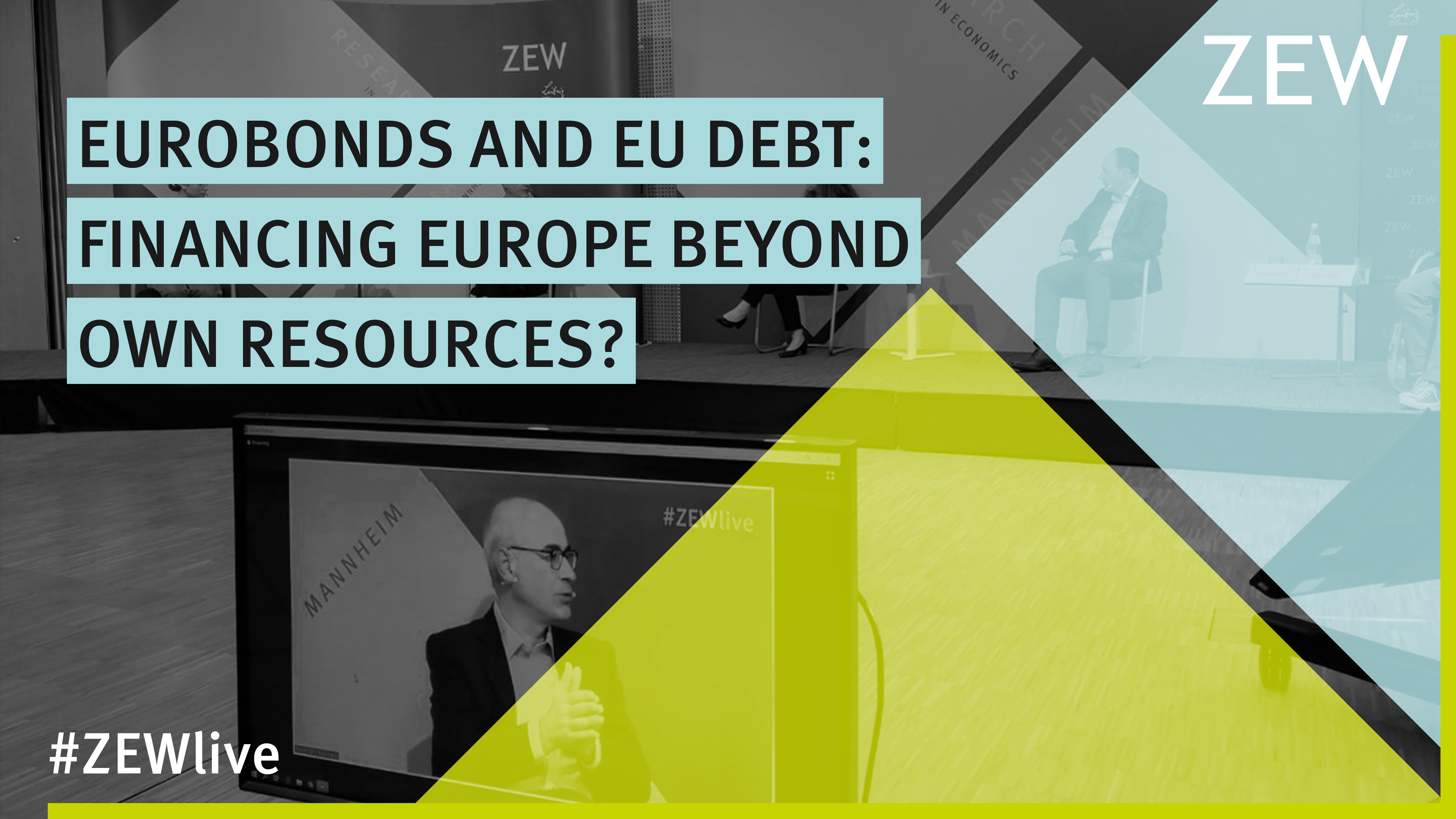
Joint European debt instruments have become significantly more important since the euro crisis. In the second #ZEWlive edition of the “EU Budget Talks”, Professor Friedrich Heinemann, head ZEW’s “Corporate Taxation and Public Finance” Research Unit, talked with Lourdes Acedo Montoya, chief economist at the European Commission Directorate-General Budget; Zsolt Darvas, senior fellow at Bruegel; and Professor Lars Feld, director of the Walter Eucken Institute and ZEW research associate. Their discussion focused on the opportunities, limitations and political risks associated with joint EU bonds. The key questions were whether EU debt contributes to the financing of European public goods, whether EU debt functions as a safe asset, and what role it could play in the upcoming Multiannual Financial Framework.
“If one takes the rationale for European public goods seriously, there is a much more immediate case for aid to third countries or for EU programmes with a clear European objective,” Heinemann noted at the outset. In practice, however, the funds from EU debt instruments largely flowed into the national budgets of Member States. This was problematic, he said, because there was no automatic guarantee that this would enhance the European dimension of national expenditure. Heinemann also pointed out that credit instruments with uniform financing conditions were particularly attractive to Member States with weaker credit ratings. Countries with very good credit ratings, on the other hand, benefited little from these instruments – even if they were strongly committed to European tasks such as defence or aid to Ukraine.
In the opinion of Lourdes Acedo Montoya, the key question is not whether the EU takes on debt, but for what purpose. She said that the purpose of the EU budget was to facilitate political objectives that Member States could not achieve on their own, or not to a sufficient degree – such as cross-border investment, competitiveness, convergence or crisis responses. Debt was not an end in itself but part of a broader fiscal policy toolkit.
She cited the SAFE programme as an example, which is set to provide 150 billion euros in loans by 2030 for the development of European defence capabilities. Such instruments could mobilise funds quickly, create security effects extending beyond individual Member States and, through integrated supply chains, generate economic impacts in other countries as well.
Zsolt Darvas sees great potential in common EU bonds in principle, but he remains cautious because of their current design. He pointed out that although the EU had a high credit rating, it paid interest rates on the market that were closer to the average for eurozone countries than to the terms offered to particularly safe nations such as Germany or the Netherlands.
Furthermore, in his view, EU bonds did not yet entirely fulfil the role of a genuine safe asset. One reason for this was that EU bonds were not included in major government bond indices, meaning that part of the investor base was missing. Darvas also emphasised that more EU debt could have advantages: It could provide monetary policy with a more uniform reference market and help banks to break their close ties to national government bonds.
Lars Feld expressed scepticism about an expansion of joint debt instruments, stating that the EU lacked the institutional foundation of a genuine federation. As long as the EU could not levy its own taxes, and as long as the Member States did not ultimately stand behind the liabilities, there was an asymmetry between decision-making, control and liability. This asymmetry created incentives for moral hazard.
He also warned against gradually shifting new tasks to the EU level without amending the Treaties accordingly. A distinction had to be made, particularly regarding defence spending: not all government expenditure in this area constituted an investment; a significant portion was current consumption, which in normal times had to be financed from current revenue. Feld therefore expects fierce distributional conflicts between Member States in the upcoming budget negotiations. At the same time, it was precisely this antagonism that could increase political pressure to create additional leeway through new debt instruments.
In the final round, all speakers agreed that the issue of joint EU debt is shaping the negotiations on the next Multiannual Financial Framework. Darvas believes it is possible that existing NextGenerationEU debt will not be repaid as planned. While he views new debt-financed instruments positively in principle, he believes that their political feasibility is limited. Acedo Montoya would like the upcoming negotiations to focus more strongly on modernisation. She emphasised that it was more important to identify the EU budget’s tangible achievements for Europe than to simply quantify the financial transfers to individual Member States.
Heinemann concluded the discussion by stating that, independently of the source of funding, the quality of spending had to be a priority. The decisive factor was whether European funds were used in a targeted, transparent and performance-oriented manner. This means that the debate on EU debt is less about a technical question of financing and more about a fundamental question of European fiscal policy.