Hardly Any Companies Forbid the Use of AI
Information EconomyRepresentative ZEW Survey of Companies in Germany

A large proportion of companies in the German information economy and manufacturing sector provide their employees with access to generative AI applications such as ChatGPT, Copilot or Gemini. By contrast, only very few firms prohibit their use: four per cent in the information economy and eight per cent in the manufacturing sector. These are the findings of a recent representative survey conducted by ZEW Mannheim of around 1,500 companies.
“In the information economy, almost 60 per cent of companies currently make generative AI applications specifically available to their workforce, thereby actively supporting the use of this new technology. In the manufacturing sector, this figure stands at 30 per cent,” says co-author Dr. Daniel Erdsiek from ZEW’s “Digital Economy” Research Unit.
“Despite its exceptionally high performance, generative AI, unlike many earlier digital technologies, is characterised by a considerably lower barrier to entry: Until just a few years ago, companies usually had to make substantial investments in order to integrate new digital technologies into their work processes. As a result, firms had much greater control over which technologies were used by their own employees. Today, however, employees can usually use generative AI tools for their work on their own initiative,” says Dr. Thomas Niebel, co-author from ZEW’s “Digital Economy” Research Unit.
Different Strategies for Dealing with AI
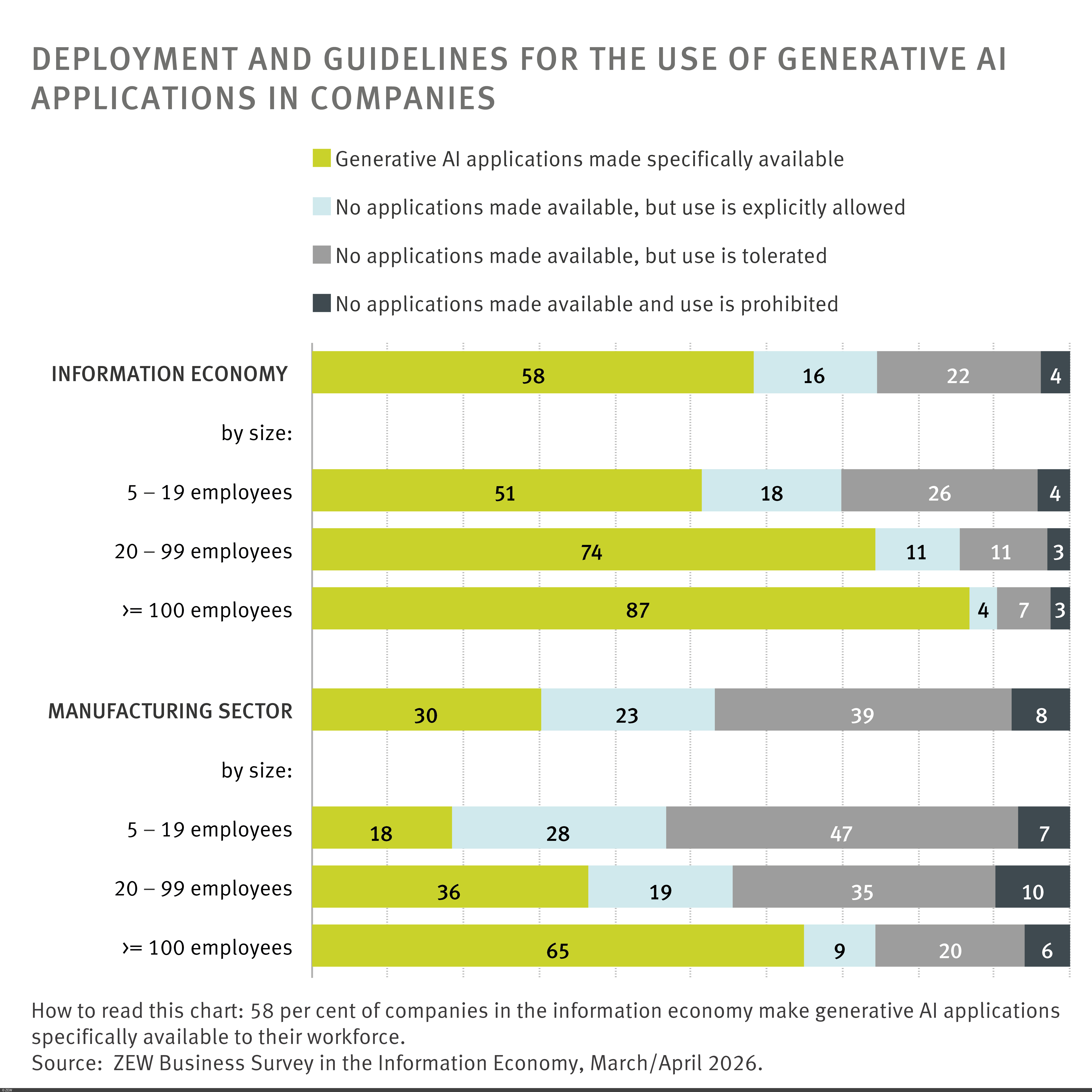
Companies that do not specifically provide access to generative AI must respond to this unfamiliar situation. In the information economy, a total of 16 per cent of companies explicitly allow the use of generative AI without providing it themselves. In the manufacturing sector, this applies to 23 per cent. The proportion of companies that have no clear guidelines but generally tolerate the use of generative AI is almost twice as high in the manufacturing sector as in the information economy (22% and 39%). By contrast, companies only very rarely prohibit the use of generative AI entirely.
Larger Companies Promote Use of AI More Frequently
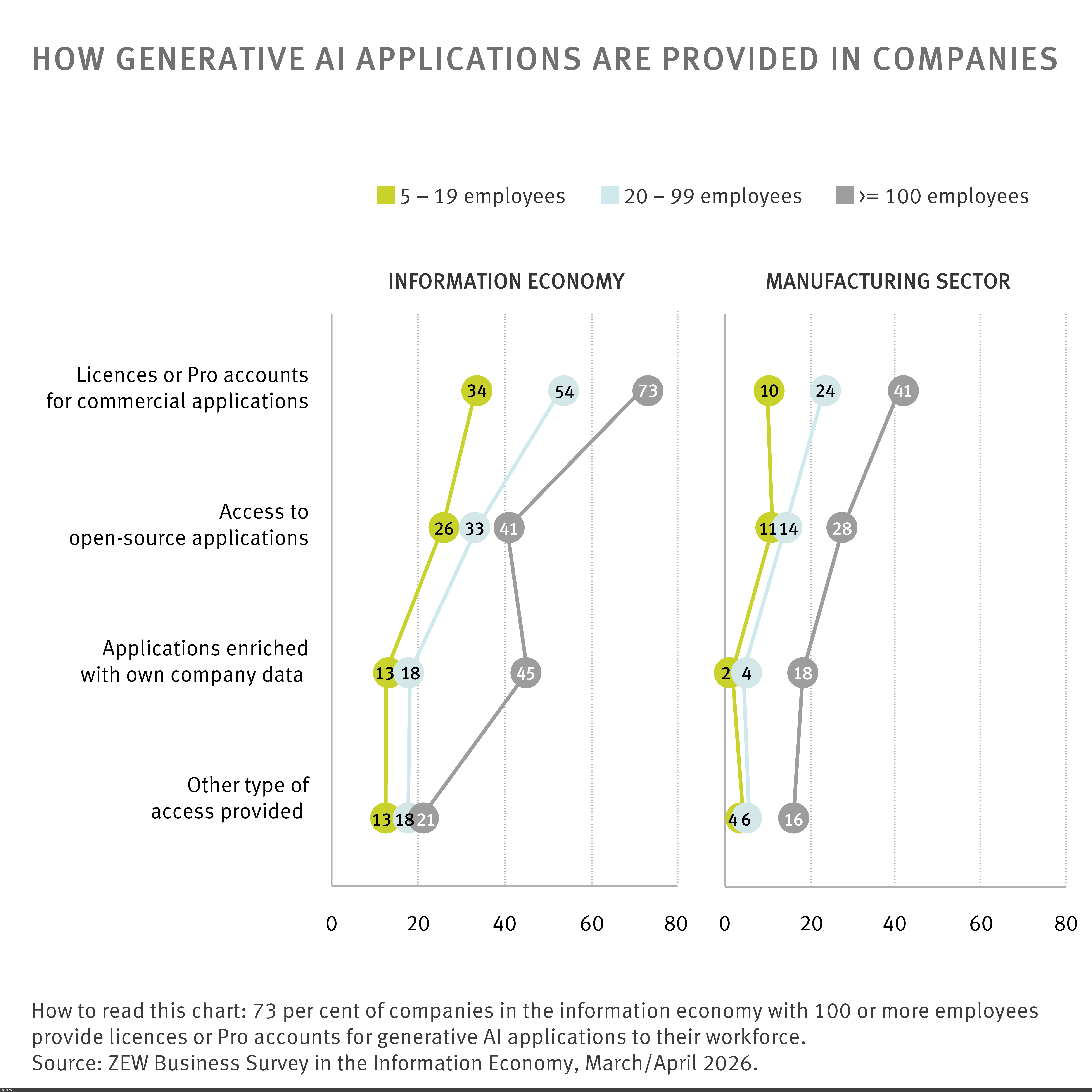
The extent to which the use of generative AI is institutionally promoted is also linked to company size. Especially companies with 100 or more employees specifically promote the use of generative AI by providing appropriate tools (87% in the information economy; 65% in the manufacturing sector).
“When providing generative AI, companies rely in particular on licences and Pro accounts for commercial providers. Open-source applications, by contrast, are used somewhat less frequently. Generative AI applications enriched with a company’s own data are currently still relatively uncommon. It is only in large companies in the information economy that such applications are made available more frequently,” says Erdsiek.
1,500 Companies Surveyed on the Use of AI
The data from March and April 2026 were collected as part of the ZEW Business Survey in the Information Economy. For this purpose, the researchers surveyed around 1,500 companies in Germany. The participants are companies from the manufacturing industry and the information economy, which comprises the ICT sector as well as media service providers and knowledge-intensive service providers.