Pressure for Reform in Germany: How Can the Right Balance Be Achieved for the Future?
EventsDGB Chair Yasmin Fahimi Speaks at “First-Hand Information on Economic Policy” Event
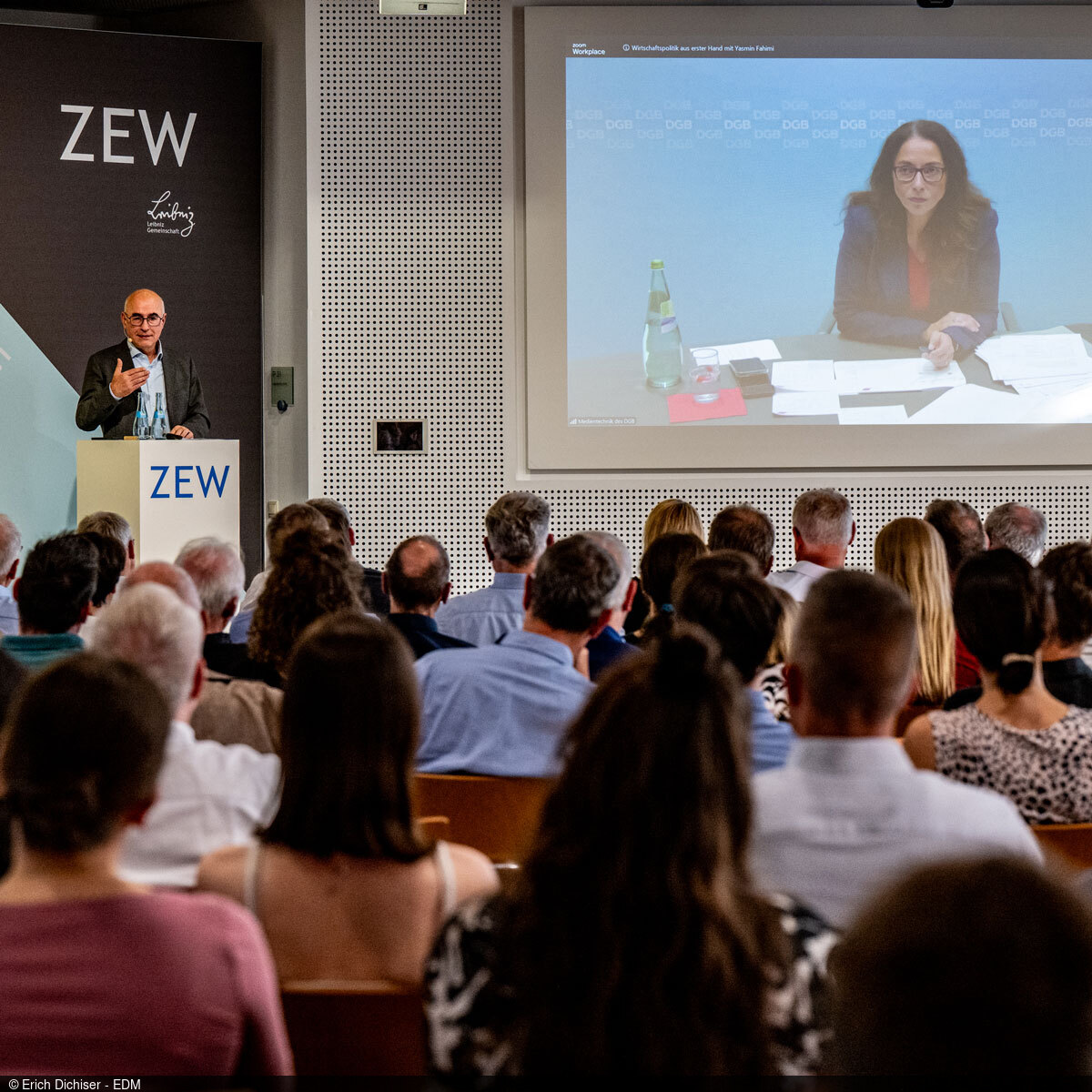
Germany is under considerable pressure to reform. Economic growth remains weak, international competition is intensifying, and there is a need for substantial investment in infrastructure, digitalisation and public services. The transformation of industries, energy supply and the world of work also present major challenges for businesses and employees alike. On 8 July 2026, Yasmin Fahimi, Chair of the German Trade Union Confederation (DGB), and ZEW President Professor Achim Wambach, PhD discussed how economic renewal can be achieved without jeopardising social cohesion. The discussion was hosted by ZEW Mannheim as part of its “First-Hand Information on Economic Policy” event series. The speakers focused on strategies to reconcile competitiveness, good work and an effective welfare state.


At the opening of the event, Achim Wambach assessed the current economic situation and discussed aspects of the reform plans recently presented by the federal government. He pointed out that in the past, when Germany’s economy was struggling, its neighbouring countries were not faring well either. At present, however, other European countries were benefiting from Germany’s weakness as a business location, as investment was redirected – other economies were growing. Although the reform package would have positive effects in the long term, the economic pressure was enormous, which was why further steps were necessary.
Shaping economic renewal in a socially responsible way
Due to the discussions surrounding the reform package that had been published shortly beforehand, Yasmin Fahimi was tied up in Berlin and unable to travel to Mannheim in person. She joined the meeting via video link. In her speech, she explained, among other things, that the proposed 34-point reform package did provide some positive signals, including for growth and investment. Current economic growth forecasts were driven by private consumption. However, according to the DGB chair, the reforms were reducing the population’s purchasing power. A growth agenda had therefore to be given the highest priority. Fahimi also emphasised that between 2000 and 2019, Germany’s GDP growth rate had been similar to that of the United States and stronger than that of other EU countries. Germany had also had a strong welfare state during this period. It was therefore mistaken, she argued, to identify the welfare state as the cause of the current weakness in economic growth.
In the subsequent discussion with ZEW President Wambach, common ground emerged. Underlining that 40 per cent of Germany’s foreign trade is with the EU, compared to only around ten per cent with the United States and China respectively, the speakers said that Germany’s export model was not dead but changing. Against the backdrop of geopolitical tensions that had intensified in recent years, trade agreements with the Mercosur countries, Canada or India were beneficial.
According to Wambach, the reform package demands concessions from all sides. He said that the government had put together a comprehensive package intended to implement a wide range of measures. In this context, Fahimi stressed that Germany needed to rethink its approach to development cooperation. A more intelligent form of cooperation with African countries was required. This field could not be left to China, which was thereby securing exclusive access to rare earth minerals.
Referring to developments in other economies, Wambach warned that an excessive use of fixed-term employment contracts without an objective reason could create a dual labour market with highly secure jobs on one side and project-based job-hopping on the other. This would not constitute a stable system. With regard to protection against dismissal, the reform package proposes that high earners currently receiving gross income of more than 177,000 euros per year should be easier to dismiss in return for severance payments. Fahimi emphasised that the debate over whether protection against dismissal prevented job creation was largely symbolic. Her main concern was that this weakening of dismissal protection could serve as a gateway to a further erosion of employee rights.
Questions from the audience
The event closed with questions from the approximately 120 attendees, directed to the DGB chair, about topics such as strengthening education from school right through to the workplace, as well as the potential negative effects of the reforms on mini jobs. The summer reception that followed was made possible through the kind support of ZEW Sponsors’ Association.