Cutting Reduced-Rate Eligibility Could Lower VAT Rate
ResearchZEW Analysis of Exceptions in the VAT System

The various reduced VAT rates in Germany lead to significant tax revenue losses, and the justifications for these lower rates are frequently unconvincing. This is the conclusion of a recent ZEW analysis commissioned by the Federal Ministry of Finance. It shows that the numerous reduced-rate provisions substantially erode the tax base: In 2026 alone, foregone revenue amounts to around 43.5 billion euros. Reducing these provisions could not only simplify the tax system but also create scope for lowering the standard VAT rate.
“Many reduced tax rates have evolved historically but are now difficult to justify. They are neither convincing from a distributional perspective nor economically sound. Instead of expanding reduced-rate provisions, tax policy should focus more strongly on a simple and transparent system,” explains Professor Friedrich Heinemann, head of the ZEW “Corporate Taxation and Public Finance” Research Unit.
Dr. Daniela Steinbrenner, a researcher in the same unit, adds: “Phasing out poorly justified reduced-rate provisions would not only improve tax revenues but also significantly reduce administrative burden and demarcation issues.”
Only a few reduced VAT rates are well justified
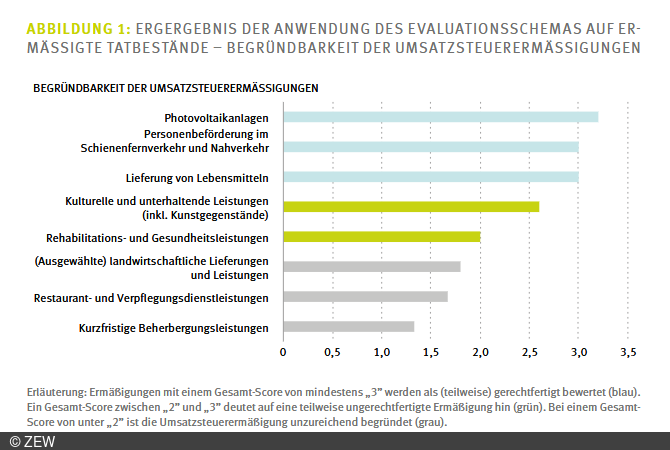
The evaluation presents a differentiated picture. Reduced VAT rates for food, public transport and photovoltaic installations are particularly well justified. These measures either achieve distributional objectives – for example by providing relief to lower-income households – or promote desirable administrative effects.
However, in many other areas, there is clearly no compelling rationale for reduced VAT tax rates. Examples are catering and accommodation services, as well as parts of cultural and health services. In these cases, higher-income households often benefit more, while revenue losses remain substantial. More targeted instruments, such as direct transfers, would typically be more efficient than broad-based VAT reductions.
Reforms could enable a lower standard VAT rate
Simulations in the analysis show that phasing out reduced-rate provisions opens up considerable scope for tax reform. If reduced VAT rates were abolished entirely, the standard rate could theoretically be lowered from 19 to 16.7 per cent.
More realistic reform options, such as retaining the reduced VAT rate for food, would still allow a reduction in the standard rate. This would simplify the tax system while significant adverse distributional effects would be unlikely.
Comprehensive tax evaluation
The findings are based on a comprehensive evaluation of reduced VAT rates using a uniform set of criteria. Among other things, the evaluation assessed targeting, distributional effects, efficiency, impacts on competition and administrative feasibility. The empirical analyses are based on data from the Income and Consumption Survey (ICS) and incorporate assumptions regarding tax pass-through and the price elasticity of demand. In addition, expert interviews with practitioners and administrators were included, and various reform options were modelled to assess their fiscal and distributional impacts.