“Closing the Gender Gap”: Financial Literacy is the Focus of ECB-Hosted Panel Discussion
Dates and NewsZEW Economist Professor Tabea Bucher-Koenen and ECB President Christine Lagarde Discuss Financial Literacy
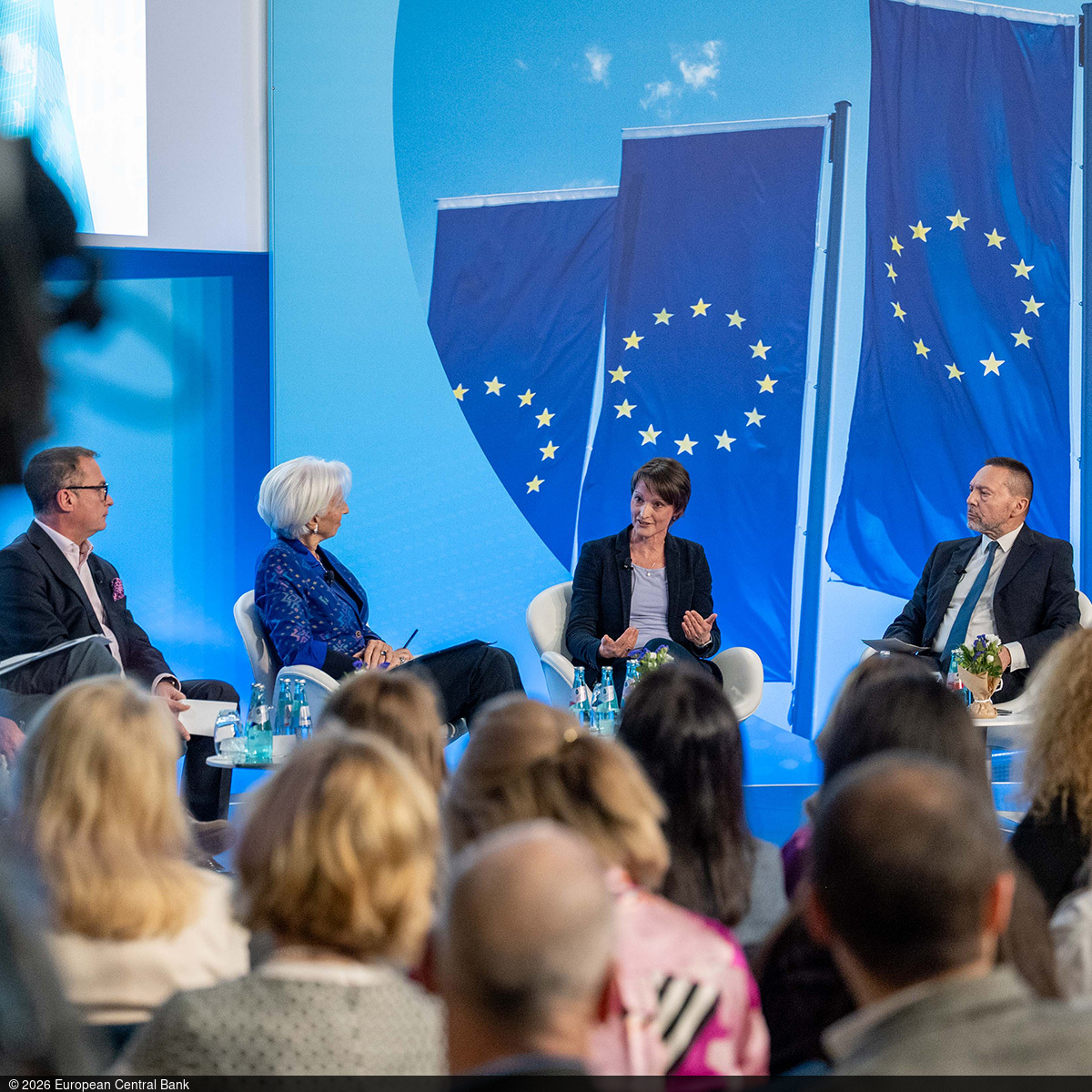
To mark the approaching International Women's Day, the European Central Bank (ECB) hosted a panel discussion titled “Closing the Gender Gap in Financial Literacy” at its headquarters in Frankfurt on 2 March 2026. The panellists were Professor Tabea Bucher-Koenen, head of ZEW’s Research Unit “Pensions and Sustainable Financial Markets”, ECB President Christine Lagarde, Bundesbank President Joachim Nagel and the Governor of the Bank of Greece, Giannis Stournaras. The focus of the discussion was on how targeted actions can help to strengthen women’s financial literacy and how their impact can be measured. The panel was moderated by Patrick Jenkins, deputy editor of the Financial Times. Representatives from media outlets, educational initiatives and social networks participated alongside policymakers.
“Financial literacy is a key prerequisite for participation and individual freedom of choice. The gender gap in financial literacy, which has remained unchanged for years, shows that much remains to be achieved in this area,” explains Bucher-Koenen. “This is not only about factual knowledge, but also about self-confidence regarding one’s own financial knowledge and financial decisions. Around 30 per cent of the gender gap in financial literacy can be attributed to women’s lack of self-confidence. Both knowledge and confidence are crucial for financial decisions such as investing in the stock market.”
Structurally promoting financial literacy
In the discussion, Bucher-Koenen explained the causes and consequences of gender-specific differences in financial education. Empirical studies showed that women on average had both less knowledge and less self-confidence with regard to key financial matters, such as compound interest, inflation and risk diversification. According to Bucher-Koenen, this gap will have a long-term impact on wealth accumulation, retirement provision and the build-up of safety cushions. She therefore advocated evidence-based educational programmes that start early and take different realities of life into account. Instead of focusing on isolated topics, financial education should adopt a broader perspective and consider structural conditions as well, for example, career breaks or part-time employment rates. It was also crucial to systematically measure the impact of actions to visualise progress and identify examples of best practice.
Lagarde emphasised the role of central banks in promoting financial literacy. Financial education was not only an individual task but also important for economic and monetary stability. Especially in times of economic uncertainty, digital financial innovations and increasing complexity of financial products, it was important to empower citizens to make informed decisions. The ECB therefore planned to expand its activities in the area of financial literacy and intensify cooperation within the Eurosystem. By involving the media, influencers and educational stakeholders, the ECB intends to tap into new target groups and increase the topic’s visibility.