Digital firms are more productive
Research
23.04.2026
Joint study by ZEW and KfW Research

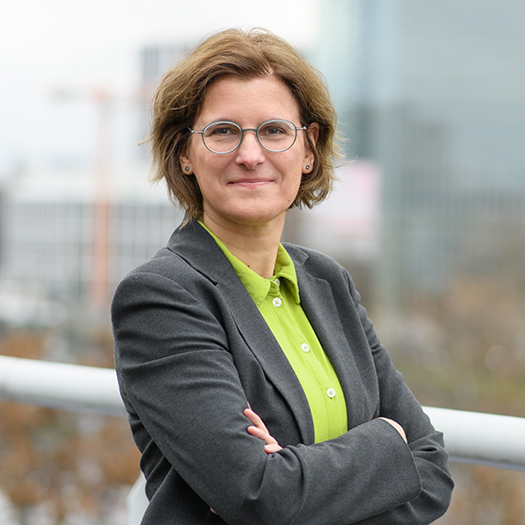
The more digital a business, the more productive it is. This correlation is stronger the more advanced an enterprise’s digitalisation already is. These are the findings of a joint study conducted by ZEW Mannheim and KfW Research. Professor Irene Bertschek, head of ZEW's Research Unit “Digital Economy”, and Dr Dirk Schumacher, Chief Economist of KfW, presented the study at a press briefing in Frankfurt on Thursday.
“The digital capital stock of a business is clearly linked to its level of productivity. The more digitally positioned a business already is, the more it benefits from spending more on digitalisation,” said Bertschek. “Evidently, more digitalised enterprises are more successful at harnessing the productivity potential of digitalisation than less digitalised ones. This finding shows that they first need to have an initial digital capital stock and experience in the use of the technologies before successes become visible.”
“In order to remain competitive, businesses must invest in their digitalisation. That investment should be made continuously and in sufficient amounts so that it has a permanent effect and really drives businesses forward,” said Schumacher. “Digitalisation often constitutes the technological basis that enables a business to innovate in the first place. Germany urgently needs innovative enterprises.”
Analysis of KfW data
The study shows that increasing the digital capital stock of an enterprise by ten per cent increases its productivity by 0.159 per cent on average. In the group of businesses with the highest initial digitalisation, increasing their digital capital by ten per cent even increases their productivity by 0.808 per cent.
A higher degree of digitalisation also helps businesses catch up with the most productive companies of their sector. Here, too, the correlation is much stronger for more digitalised enterprises than for a less digitalised ones.
It is important to note that digital capital is very unevenly distributed in Germany. The 25 per cent of SMEs with the highest digital capital stock have EUR 156,600 on average. On the opposite end of the spectrum, the digital stock of the 50 per cent of businesses with the lowest digital capital averages less than 50 euros.
These low amounts are due to the fact that small businesses in particular spend only small amounts on digitalisation and only in irregular intervals. Combined with the rapid rate of depreciation of digital capital, this causes the stock that has been built up to be depleted again quickly in subsequent years.
The analysis was performed on the basis of data from the KfW SME Panel for the years 2017 to 2022. The KfW SME Panel is the only representative survey of the entire German SME sector. It surveys enterprises with an annual turnover of up to EUR 500 million. The digital stock of businesses was calculated based on the data they provided about their expenditure on digitalisation projects. This includes expenditure for projects as well as measures and projects aimed at modernising the IT structure, digitalising products, customer and supplier relations, and redesigning workflows.
KfW study: digital expenditures have declined
The new Digitalisation Report by KfW Research, which was also presented on Thursday, shows that the digitalisation activities of German SMEs have recently declined across all economic sectors. The share of enterprises that completed digitalisation projects between 2022 and 2024 fell by five percentage points to 30 per cent compared with the years 2021 to 2023. Companies invested a total of EUR 23.8 billion in their digitalisation, a decrease of EUR 8.1 billion, and even EUR 8.6 billion when adjusted for price variations.
“The surge in digitalisation triggered by the COVID-19 crisis has fizzled out. This can surely be attributed in part to the difficult economic situation, which is affecting the investment behaviour of businesses,” said Schumacher.
From a historical perspective, however, SMEs’ digitalisation activities have increased. The share of businesses with completed projects and the aggregate and average digitalisation expenditure of digitally active businesses are higher today than just under a decade ago.
Still, digitalisation activity remains heavily concentrated in large and pioneering enterprises. Thus, the share of businesses with completed digitalisation projects is more than twice as high among large SMEs with 50 and more employees than in the group of small businesses with fewer than five employees.
“Investing in digitalisation pays off in the medium to long term. From an economic-policy point of view it makes sense to convince businesses of the need to digitalise operations and provide targeted incentives to strengthen digitalisation efforts,” said Schumacher. “Particularly in small and medium-sized enterprises, financial resources are often limited. Providing financial support therefore is an important starting point.”
Bertschek said: “Another approach is to cooperate with digital start-ups whose technological expertise can benefit small and medium-sized enterprises in particular. What is also of key importance is to enhance and regularly upgrade digital skills. They are crucial for businesses to reap the benefits of digitalisation. Incorporating digital skills in school, vocational and academic curricula is one way of strengthening basic digital competencies.”