Sound Budgeting Takes Tomorrow into Account
Research
12.03.2026
Joint press release by WWF and ZEW on the Future Ratio 2025
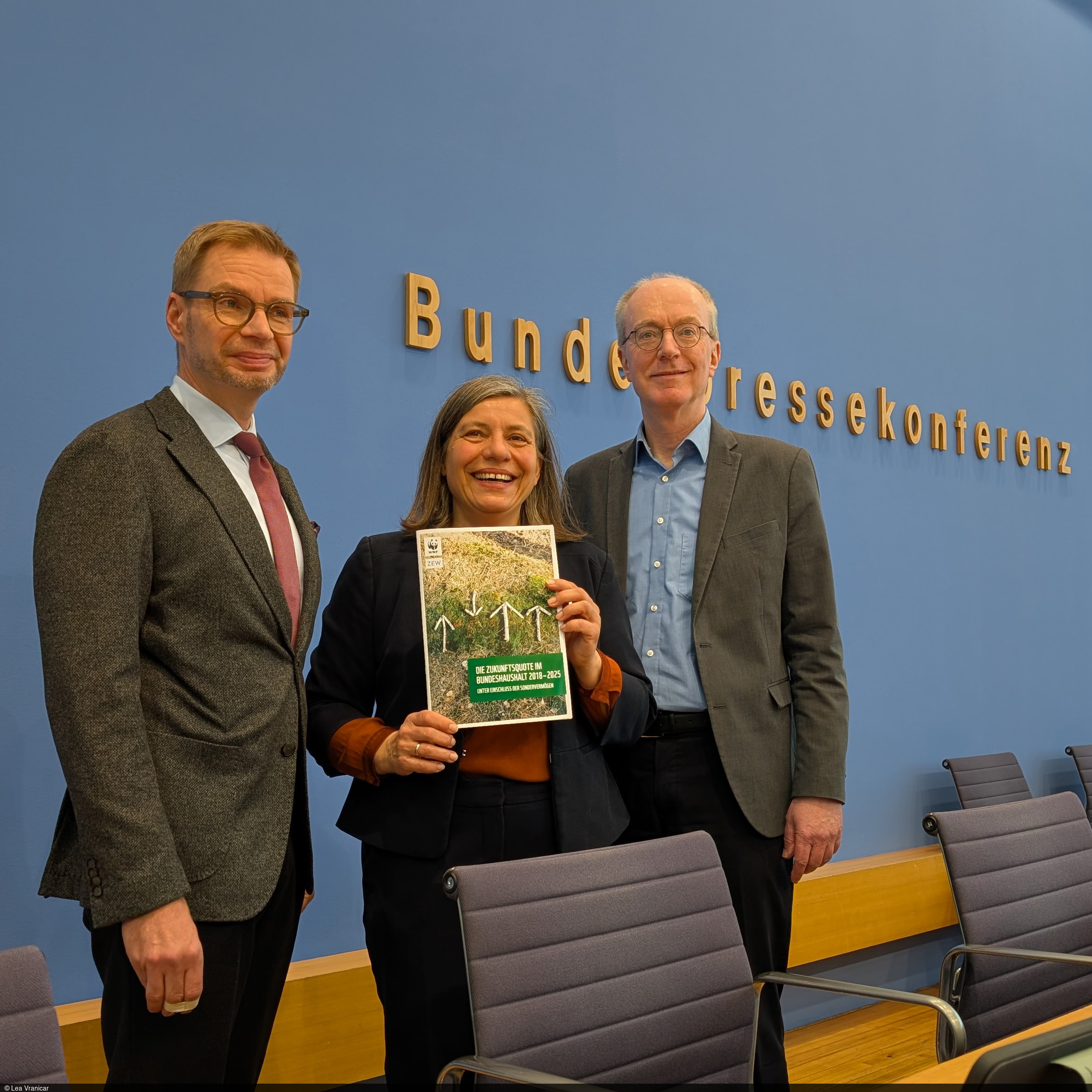
Current investments in the future are primarily funded through temporary special funds rather than drawing from the core budget. Consequently, there is a high risk of insufficient resources being available in the long term for vitally important areas such as climate action and education. This is one of the key findings of the Future Ratio calculations for the 2025 budget, made by ZEW Mannheim in collaboration with WWF.
The Future Ratio calculates the amount and proportion of investment flowing into forward-looking areas ranging from physical capital formation, climate action and environmental protection to education and technical knowledge. According to the analysis of the 2025 budget, the share of future-oriented expenditure – at 22 per cent, or 125 billion euros in absolute terms – is higher than in previous years. However, the rise in future-oriented expenditure is driven solely by special funds, in particular the Special Fund for Infrastructure and Climate Neutrality. In the core budget, both the proportion and the absolute amount of future-oriented expenditure have been declining for the second year running. Also, despite higher net borrowing, only around a third of this borrowing is allocated to future-oriented investments.
“The Future Ratio can serve as a compass through the maze of the federal budget and become an important steering instrument for policymakers. It also offers the chance to break the deadlock in the debate on the debt brake and to enforce a stronger commitment to using debt solely for future-oriented investments,” says Professor Friedrich Heinemann, head of the Research Unit “Corporate Taxation and Public Finance” at ZEW Mannheim.
Viviane Raddatz, Head of Climate at WWF Germany, says: “We need to make sure funds are channelled in a way that secures our livelihoods today and tomorrow and enables long-term economic and social stability. Investments in climate action, the environment and education pay off many times over. Subsidies for the consumption of fossil resources, on the other hand, come at a high cost to us. This is why it is so important to establish transparency about the future-orientation of expenditure, so that it can then be systematically embedded in the budget. The climate action programme also urgently needs an adequate financial basis. Currently, future-oriented expenditure is far below what would be necessary to modernise infrastructure, meet climate targets and enable economic transformation. In the climate sector alone, over 50 billion euros of additional public investment is needed per year, partly to stimulate private investment. Special funds can only create short-term leeway here but cannot solve the structural problem. Reliable and long-term funding is essential for investments in the future.”
Reiner Holznagel, President of the German Taxpayers’ Association, comments on the publication of the analysis as follows: “The government increasingly uses special funds to finance investments through debt. But far too often these billions are not actually spent on investment. If the state takes on new debt, this must be channelled into genuine future-oriented investments with added value – such as transport or educational infrastructure. The Future Ratio provides transparency about whether new debt is actually being put to good use. Ultimately, we must not add to the debt mountain and leave future generations – Germany’s future – to deal with the growing interest burden. That is why we need more budgetary discipline, clear priorities and an honest investment policy enshrined in the core budget.”
Background
Future-oriented investments, as defined by the Future Ratio, are government expenditure on education, infrastructure, climate action and nature conservation, and the advancement of technical knowledge. They are the foundations for sustainable living and economic prosperity. The Future Ratio shows at a glance what proportion of the federal budget is channelled into this future-oriented expenditure. ZEW has been calculating the Future Ratio since 2021. In collaboration with the WWF, this metric has now been further developed and will be continued in the coming years. The joint project between the WWF and ZEW addresses a current gap in fiscal policy: Whilst the necessity of sustainable transformation has been understood by many, there is no benchmark to assess whether the federal budget is aligned with this goal.