When Health Becomes a Question of Justice
Events
15.10.2025
Chair of the Ethics Council Discusses with ZEW President
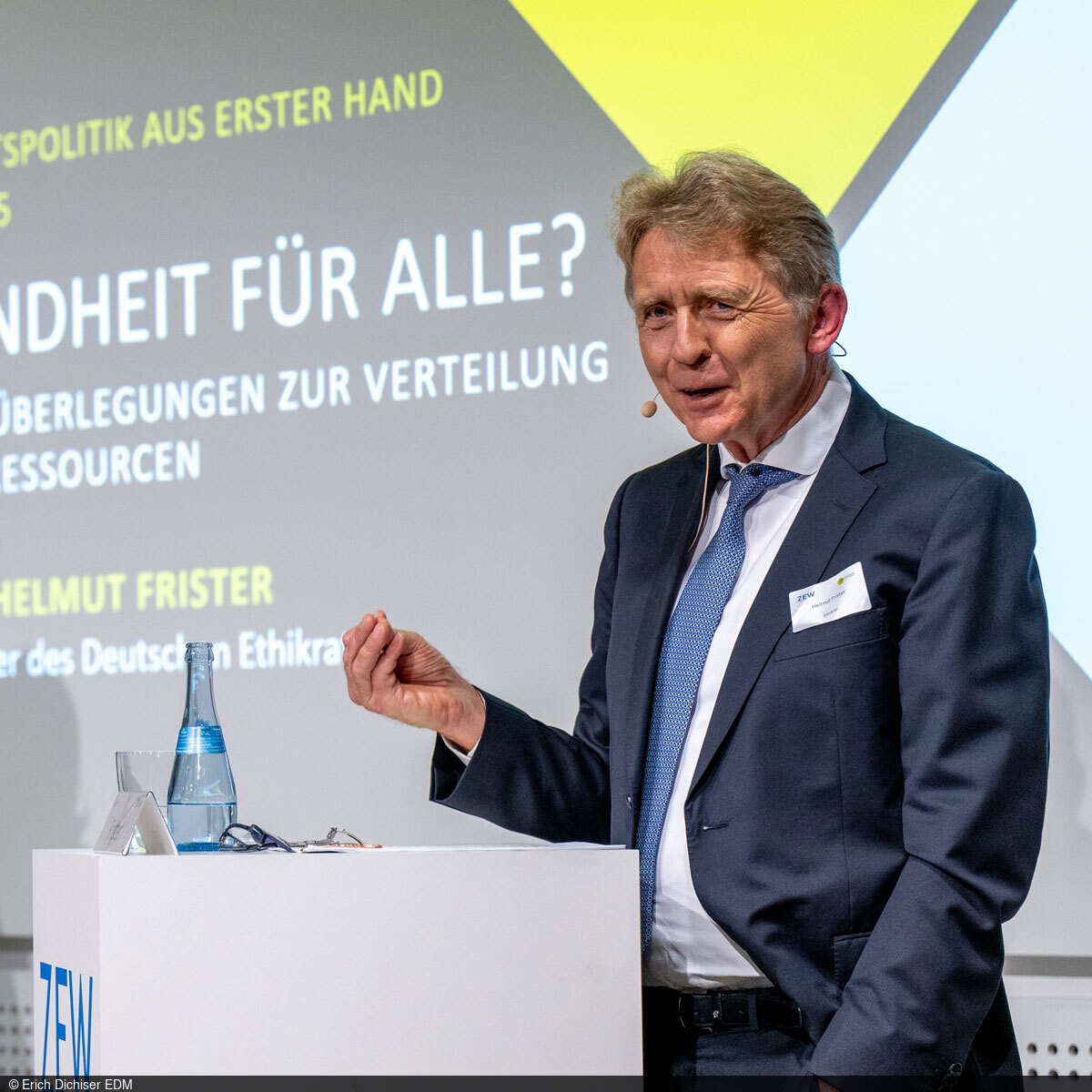
As part of the event series “First-Hand Information on Economic Policy”, ZEW Mannheim hosted a lecture by Professor Helmut Frister, Chair of the German Ethics Council, on 14 October 2025. Afterwards, Frister engaged in a discussion on medical ethics with Professor Achim Wambach, PhD, ZEW President and member of the Council.
Under the title “Health for All? Ethical Reflections on the Distribution of Scarce Resources”, Frister highlighted ethical issues that arise from conflicts between individual health care provision, social solidarity and economic limitations. In his opening remarks, he emphasised that it was both a great honour and a pleasure for him to deliver his lecture at ZEW.
Multiple challenges facing distribution
Frister began by noting the increase in health care expenditure in Germany by roughly twice the rate of GDP since the turn of the millennium. He explained that the driving factors were the constant development of new treatment options and demographic change, which was usually discussed more in relation to pensions. Frister said that he expected this trend to continue in the future and it was therefore necessary to organise health care as efficiently as possible. However, this also involved restricting services to a certain extent, which raised ethical questions and dilemmas.
Referring to overtreatment as one major issue in this context, Frister said the exact extent and the significance of non-indicated or overly expensive therapies were difficult to estimate. International figures suggested that around 20 per cent of health care expenditure was devoted to overtreatment, and he estimated a similar share for Germany. Such practices could not be entirely eliminated, but they had to be reduced. According to Frister, responsibility for this lay with doctors, though state authorities also had a duty – for instance, by establishing efficient monitoring systems and avoiding financial incentives that encourage overtreatment.
Frister added that Germany continued to uphold the principle that all necessary treatments should be available regardless of cost. Nonetheless, prioritisation was unavoidable – and not just for financial reasons. Using the example of organ donation, he emphasised that two criteria were fundamental when allocating scarce resources: urgency on the one hand and the likelihood of successful treatment on the other.
Health policy dilemmas

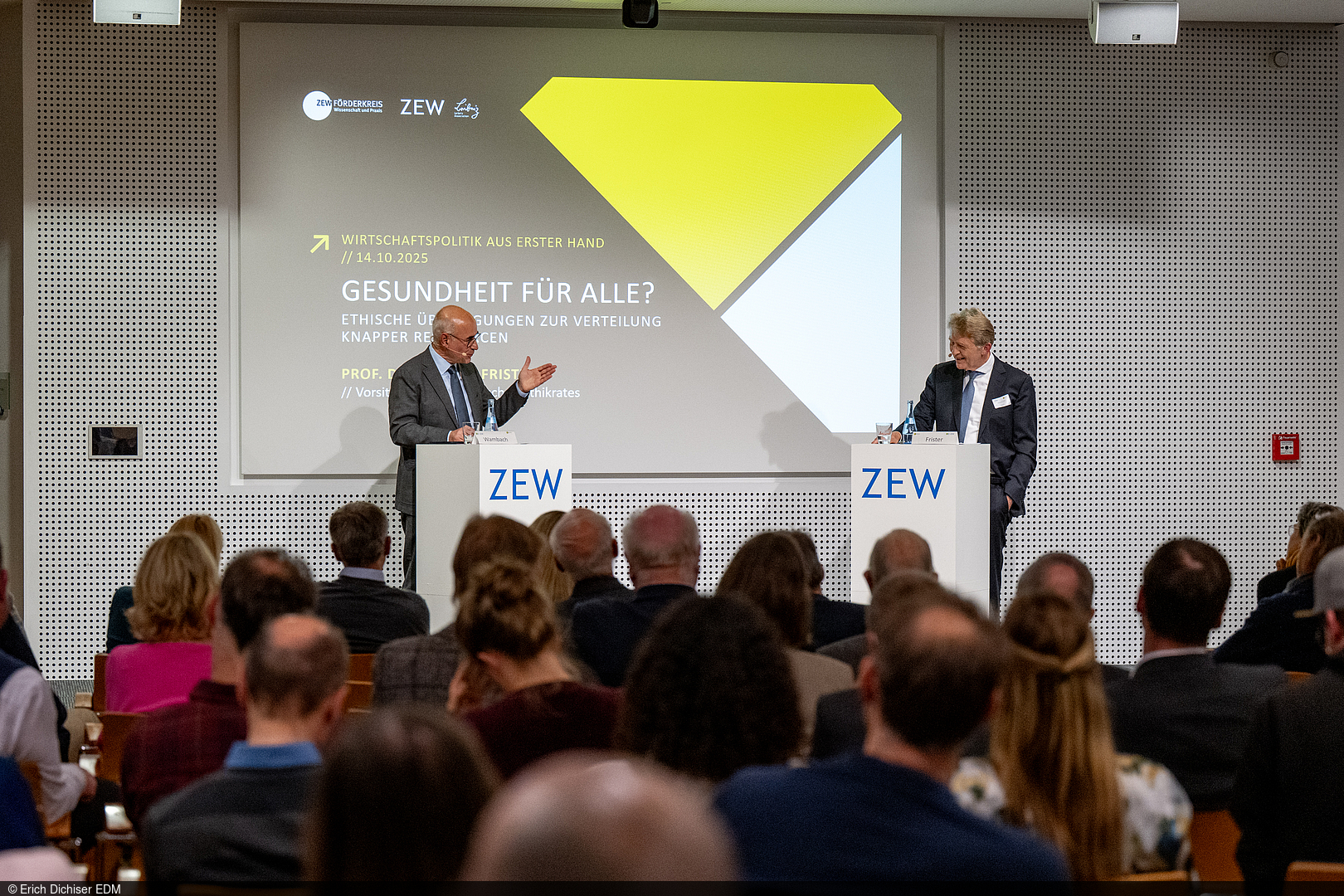
The subsequent discussion between ZEW President Achim Wambach and Helmut Frister bridged ethics, economics and practice. For example, Achim Wambach stressed that health was a superior good, which meant that wealthier people did not only spend more money on health proportionally, but also in relative terms. In the panel discussion, the speakers discussed the role of statutory health insurance in helping patients make informed decisions, but also the problems involved in weighing up which patient group would be given preference in cases of doubt.
In the concluding Q&A session, further topics were touched upon. Among other things, it was mentioned that the health care market itself imposed restrictions, as in the case of rare diseases for which treatments are hardly available due to limited profitability. It was also pointed out that health care costs did not necessarily rise with age, but rather with proximity to death. The question of what factors could motivate people to donate more blood was also discussed.
The lively exchange with the experts continued during the following reception, which was made possible by the kind support of the ZEW Sponsors’ Association.