More Debt for a Future-Proof EU?
Events
14.07.2025
“First-Hand Information on Economic Policy” at ZEW Mannheim on the Multiannual Financial Framework (MFF) in the EU
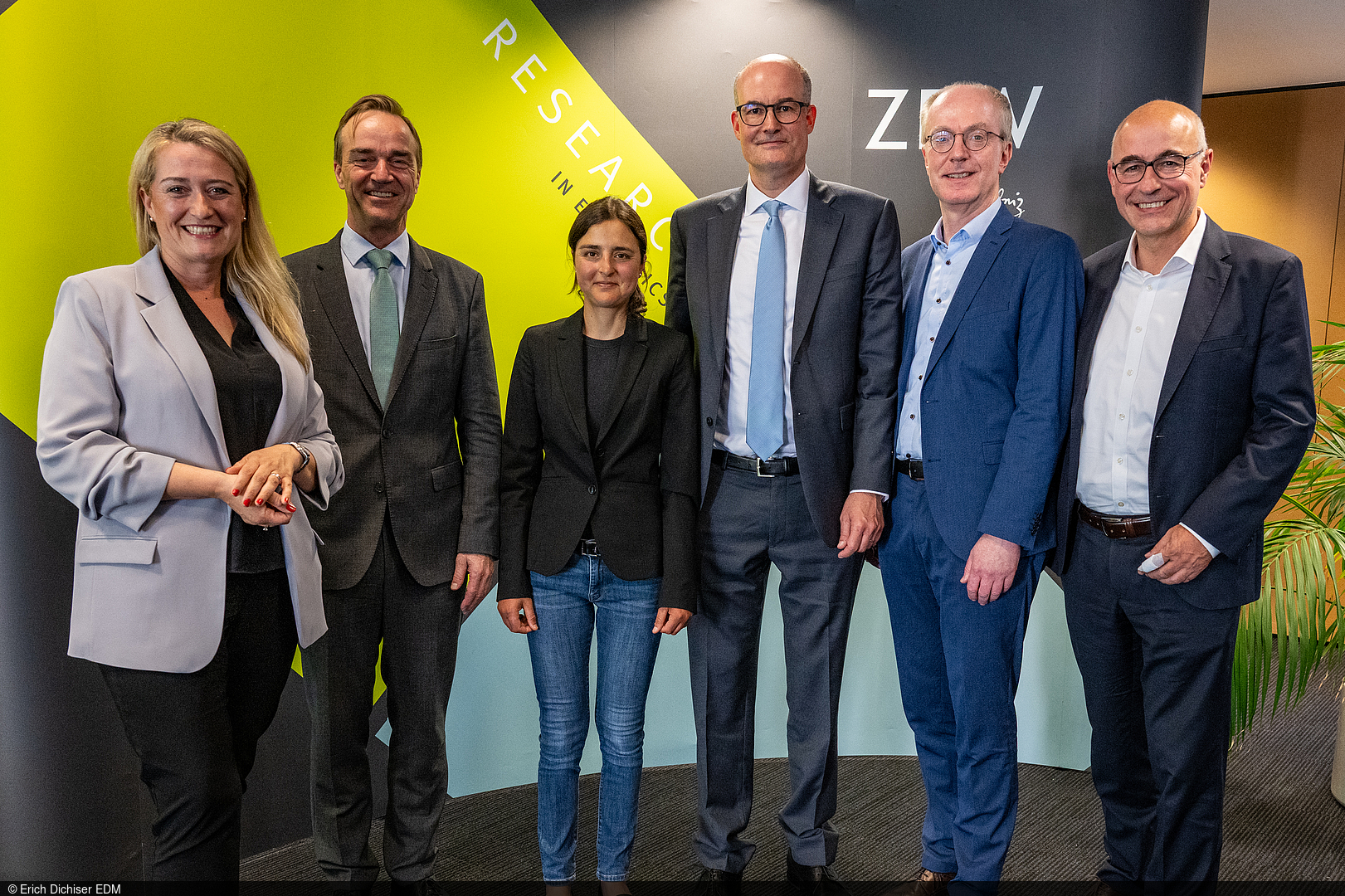
Escalating international trade disputes, new security threats and eroding competitiveness – the economic and financial policy environment in Europe is undergoing dramatic change. In this context, the upcoming Multiannual Financial Framework (MFF) of the EU must reflect these new realities. This raises the question of whether the current structure of EU budget expenditure is still appropriate. As part of the “First-Hand Information on Economic Policy” event series, a panel of experts discussed this issue under the moderation of ZEW economist Professor Friedrich Heinemann on 11 July 2025 at ZEW Mannheim. The event was organised as part of the ZEW Alumni Day and with the kind support of the ZEW Supporters' Association.


EU Debt and Fiscal Transparency
ZEW President Professor Achim Wambach, PhD, opened the event and immediately highlighted the influence of the Draghi Report, which is currently shaping the debate on European debt. Friedrich Heinemann then stressed in his keynote speech that debt has a long history at the European level. While such debt might seem politically attractive, Heinemann argued that it creates misguided incentives for heavily indebted member states.
He also pointed out that Germany is indirectly liable for around 262 billion euro under the “NextGenerationEU” recovery fund. This burden arises from grants, guarantees and loans for which Germany shares responsibility. So far, the scale of these commitments has been underestimated in public debate. In Heinemann's view, it is urgently necessary to allocate EU debt at national level in order to overcome the existing lack of fiscal transparency. Otherwise, there is a risk that member states will gain additional fiscal leeway without it appearing in national debt statistics.
More budget discipline in times of crisis?
Rolf Strauch, PhD, Chief Economist and Management Board Member at the European Stability Mechanism (ESM) and the European Financial Stability Facility (EFSF), emphasised the need for the EU to respond collectively to geopolitical and economic upheavals. According to Strauch, greater fiscal cooperation in Europe would be desirable, especially on issues such as defence and climate change. With regard to the revision of the European fiscal framework, he emphasised that the aim should be to ensure long-term debt sustainability without hindering necessary future investment.
Dr. Samina Sultan, Senior Economist for European Economic Policy and Foreign Trade at the German Economic Institute (IW Cologne), observed that the EU is caught in a field of tension between enormous investment needs and extremely limited fiscal space. Public debt is already very high in many member states. Without strict budgetary discipline and clear prioritisation of spending, she warned of a crisis that could severely restrict the EU's political room for manoeuvre. A solid fiscal policy must urgently keep an eye on the expenditure side.
Dr. Felix Hüfner, Chief Economist for Germany and Europe at UBS Investment Bank and ZEW alumnus, offered a different perspective. He pointed to an erosion of trust in the US dollar, which could enhance the attractiveness of the eurozone. However, Europe continues to lag far behind the United States in terms of economic growth. Europe must offer international investors more in this regard and make itself an attractive location. Hüfner explains that this should not be achieved through debt alone; instead, structural reforms are needed to increase competitiveness, for example through more relief for companies.
Outlook: Setting new priorities
With regard to the ongoing reform of the EU’s fiscal framework, Sultan concluded by calling for a stronger focus on innovation, artificial intelligence, and energy – rather than on agriculture and cohesion policy. Strauch stressed that in the area of defence, concrete requirements must be identified and corresponding financial resources made available accordingly.