Karlsruhe Institute of Technology (KIT) Honours Outstanding Scientific Contributions to Market Design and Competition Policy
ZEW PresidentHonorary Doctorate for Professor Achim Wambach, PhD
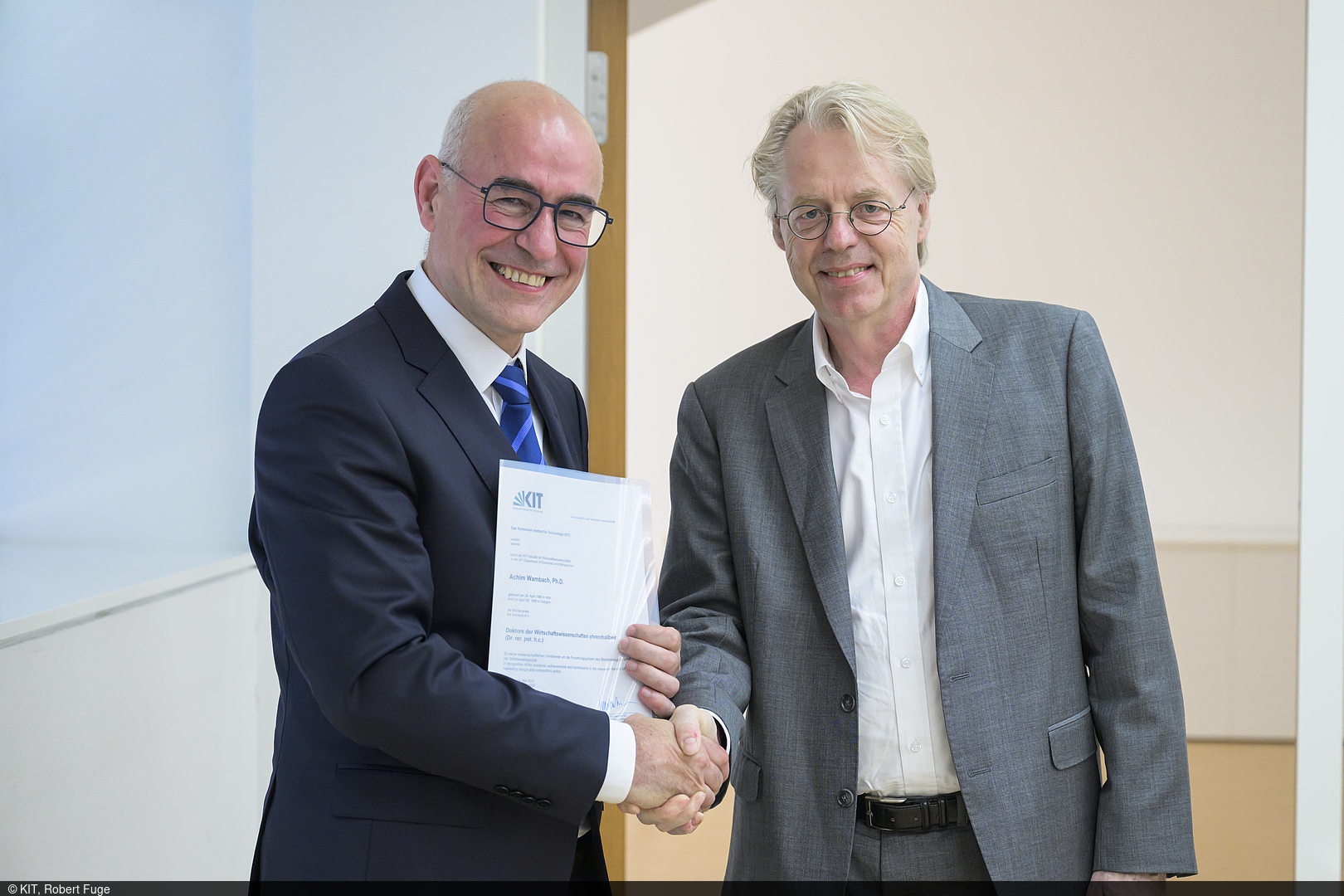
The Karlsruhe Institute of Technology (KIT) has awarded an honorary doctorate to Professor Achim Wambach, PhD, President of the Leibniz Centre for European Economic Research (ZEW). With this honour, the university recognises his internationally renowned research achievements in the fields of market design and competition policy, as well as his contribution to the evidence-based shaping of economic policy frameworks.
The award was presented during an academic ceremony at KIT in Karlsruhe. An honorary doctorate is the highest honour a university can bestow upon individuals who have rendered outstanding services to science and society.
Professor Jan S. Hesthaven, President of KIT, emphasises the scientific significance of Professor Wambach’s work: “The honorary doctorate is one of KIT’s highest honours. It is deliberately awarded only on rare occasions. I am therefore all the more delighted that we are honouring Professor Wambach today. Professor Wambach epitomises the combination of scientific excellence and societal relevance in a special way. He demonstrates how science can have an impact beyond the boundaries of its own discipline.
Wambach’s scientific work focuses in particular on the design of markets and the shaping of market rules in regulated industries, as well as on the challenges facing competition policy in an increasingly digitalised economy. Through his contributions, he has provided important impetus for the further development of competition economics and strengthened the scientific basis for economic policy decisions in Germany and Europe. He has contributed his insights to policy-making through his work on numerous advisory boards and commissions, including the Monopolies Commission, which he chaired from 2016 to 2021.
“I am delighted to receive this special honour,” said Achim Wambach. “Markets are complex structures. Well-designed markets contribute to the prosperity of society. Poorly designed or poorly regulated markets can destroy value. I feel privileged to be able to work and conduct research in this field, and to be able to apply the insights gained to practice and policy. This honorary doctorate is therefore also a recognition of the collaborative work carried out with many colleagues and fellow companions from the worlds of politics and business.”