Earnings Losses After Birth of First Child Far Higher than Previously Thought
Research
24.10.2025
ZEW Study Corrects Biased Research Results

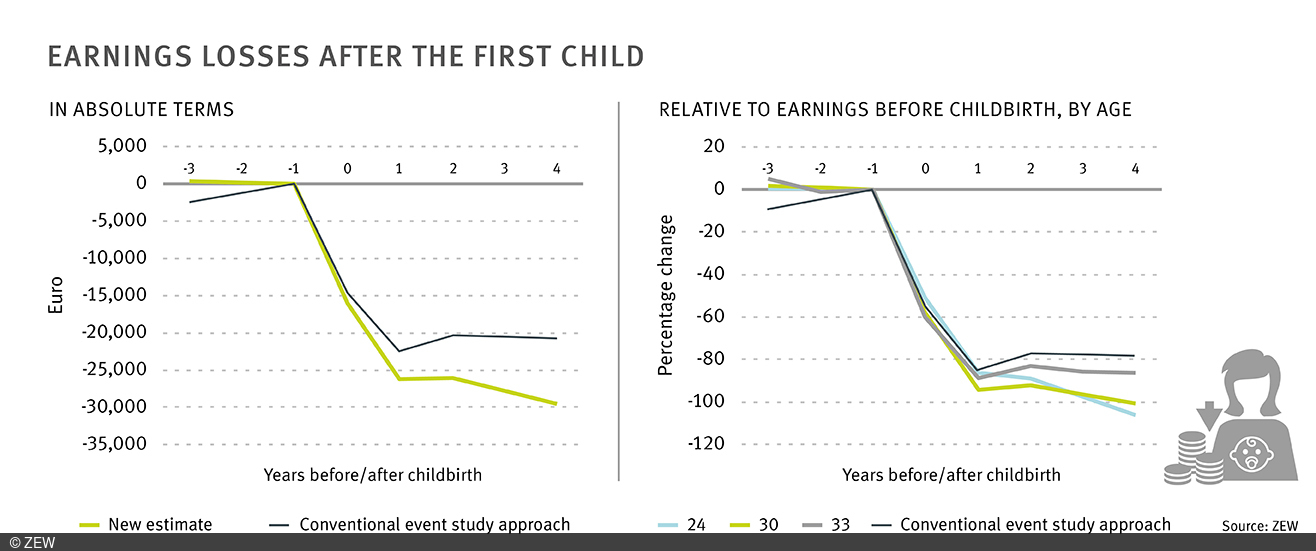
Women in Germany incur a much higher loss of earnings after the birth of their first child than previously estimated. In the fourth year after childbirth, they earn on average nearly 30,000 euros less than women of the same age without children – with long-term effects on their career and future pension income. Previous estimates were around 20,000 euros, which is about 30 per cent too low. These are the findings of a study conducted by ZEW Mannheim together with the University of Tilburg.
“Women who become mothers for the first time below the age of 30 not only suffer losses in their current earnings, but also miss out on major career steps in the important early stage of their professional development, with corresponding consequences for their future careers. Women who have children at a later age have already gone through this phase – often associated with high wage growth – and have established themselves in the labour market. As a result, the negative impact on their earnings levels is greater in absolute terms, for example because they reduce working hours. But in the long term, they are better able to resume their careers after having a child. The losses after the first childbirth therefore develop differently for mothers of different ages," explains study co-author Dr. Lukas Riedel from the ZEW Research Group “Inequality and Public Policy”.
“The older the women, and the more professional experience they have, the lower the losses after a few years compared to the earnings before childbirth. As younger mothers also miss out on earnings growth, their relative losses are greater and also show a clearly negative trend in the period after childbirth. So they often cannot make up for the career gap after having a child,” Riedel adds.
Biased results corrected
The observed earnings loss for women after the first child is often referred to as the “child penalty”. The approach currently used to estimate this loss is referred to as event study. Research methodology has been developed further, however, and as a result, ZEW researchers are able to show in their study that conventional event studies have weaknesses and lead to biased results.
If the age at first childbirth is not taken into consideration, mothers are compared with each other without taking into account that both groups already experience the effects of childbirth on their earnings. However, for the results to be reliable, mothers would have to be compared with women of the same age who do not yet have children. The authors therefore propose an adjusted procedure: “Our estimation method only uses clean comparisons with women of the same age who do not yet have a child. This allows us to map the earnings development for women without children realistically and at the same time take into account the more advanced careers of older mothers,” says Valentina Melentyeva, co-author from Tilburg University in the Netherlands.
“This approach not only enables us to estimate the loss of earnings after childbirth as a function of the mother’s age, it also provides a tool for analysing the different causes behind the differences in earnings,” Riedel adds.
Official statistics on over 186,000 mothers
The ZEW study reviews the conventional event study model, which has traditionally been used to determine the earnings losses after the first childbirth. The study uses administrative data on over 186,000 mothers in Germany, which are provided by the ”Sample of Integrated Labour Market Biographies”, collected between 1975 and 2021.
Generally speaking, the loss of earnings due to childbirth has long-term effects. The comparatively more traditional gender roles in Germany and a childcare system that, despite several expansions, does not usually cater to the requirements of full-time work, often contribute to mothers working part-time on a permanent basis. This also frequently results in lower pension payments.