ZEW and WWF Discuss Future-Orientation of National Budget
Events#ZEWLive: Future Ratio in the Federal Budget – A Governing Tool for Intergenerational Justice?
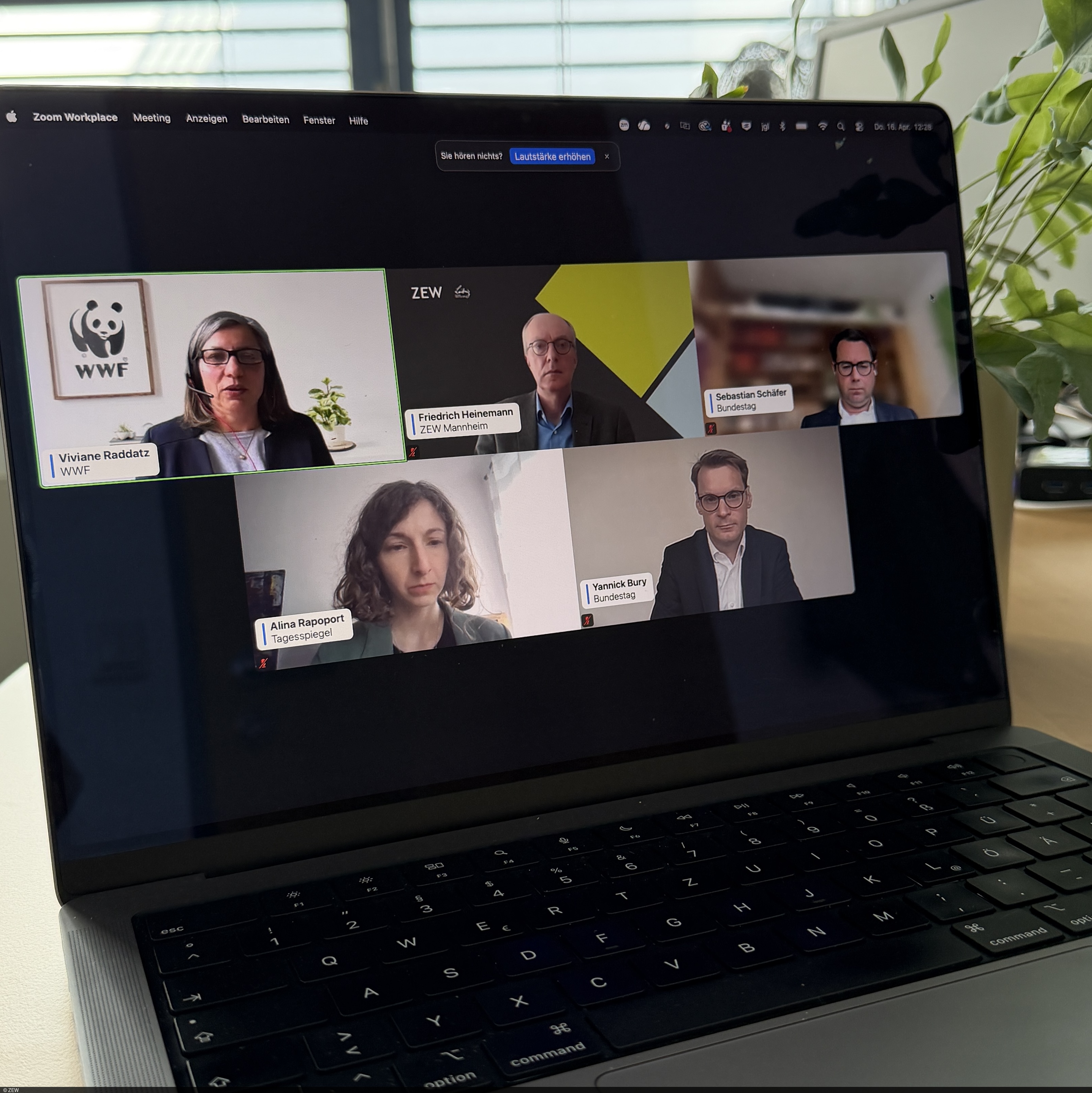
How forward-looking is the federal budget? This question was the focus of an episode of #ZEWlive on 16 April 2026, in which ZEW Mannheim and WWF Germany presented the updated ‘Future Ratio’. The Future Ratio is an indicator that provides a clear picture of the proportion of future-oriented expenditure in the federal budget. Professor Friedrich Heinemann, head of the Research Unit “Corporate Taxation and Public Finance” at ZEW Mannheim, presented key findings and discussed them with Viviane Raddatz (head of Climate at WWF Germany), Dr. Yannick Bury and Dr. Sebastian Schäfer (both members of the German Bundestag) in a panel discussion.
Webinar recording on YouTube
Click the button below to reload the content. (I agree to external content being displayed to me. Read more in our privacy policy).
“We have some good news and some bad news regarding the first federal budget following the debt brake reform. The good news is that the federal government has never spent so much on future-oriented tasks since we began measuring this in 2018. In absolute terms, this expenditure has almost doubled between 2018 and 2025, albeit without adjusting for inflation. Unfortunately, there is also some bad news. In the core budget, the share of future-oriented expenditure in the 2025 federal budget is already falling again. This means that the future-orientation of spending depends entirely on the special funds with their limited duration,” explained Professor Friedrich Heinemann at the beginning of his presentation. The Future Ratio for the overall budget showed that the federal government had not yet fully exploited the opportunities offered by the debt brake reform to adopt a more future-oriented approach.
“In the 2025 core budget, we are once again seeing a shift towards short-term expenditure, while financing for areas that are relevant for the future is being outsourced to special funds. This raises the question of how future-oriented expenditure can be financed in the long term,” said Heinemann with regard to the 2025 federal budget, adding that a key shortcoming of current budgetary management lay in the fact that thinking about the future was too narrowly focused on physical capital investment, while other important future-oriented areas such as education, research and nature conservation received too little attention. He said that the Future Ratio provided transparency across departments as it showed what proportion of the budget contributed to strengthening future prosperity.
How to reconcile growth and climate action in the budget
Viviane Raddatz explained that a sustainable federal budget must provide adequate funding for long-term government objectives such as climate action and the preservation of natural resources. She said that in her view, future-oriented expenditure in the budget had to be consistently geared towards transformation. This required additional investment in renewables, energy efficiency, climate-friendly mobility and building renovation, as well as in the protection of forests, moors and biodiversity.
Dr. Yannick Bury emphasised the importance of sound public finances for Germany’s long-term stability and competitiveness. He added that, in view of the increases in expenditure, defining key priorities was essential. Drawing on his “fossilisation” analysis, Bury also warned against an increasing rigidity in spending structures, which could restrict the state’s financial room for manoeuvre.
Dr. Sebastian Schäfer particularly highlighted the importance of future-oriented investments. He advocated using the budget as a key instrument for tackling current transformation challenges, for example, climate action, the energy transition and modernisation of infrastructure. In this context, Schäfer underlined the importance of goal- and impact-orientation for utilising public funds efficiently and aligning priorities consistently with sustainable growth.
About the Future Ratio
In the context of the Future Ratio, investments in the future refer to government spending on education, infrastructure, climate and nature conservation and the advancement of technical knowledge, which create sustainable foundations for living and economic activity in the long term. The Future Ratio shows what proportion of the federal budget is allocated to these future-oriented investments. ZEW has been calculating the Future Ratio since 2021. In collaboration with the WWF, the ratio has now been developed further and will be continued over the coming years. The joint project between the WWF and ZEW addresses a current gap in fiscal policy: Whilst the necessity of sustainable change is widely recognised, there is no benchmark to assess whether the federal budget is aligned with this objective.