Researchers Discuss Current Theoretical and Applied Approaches to Market Design
Workshop
10.07.2025
European Workshop on Market Design 2025 at ZEW
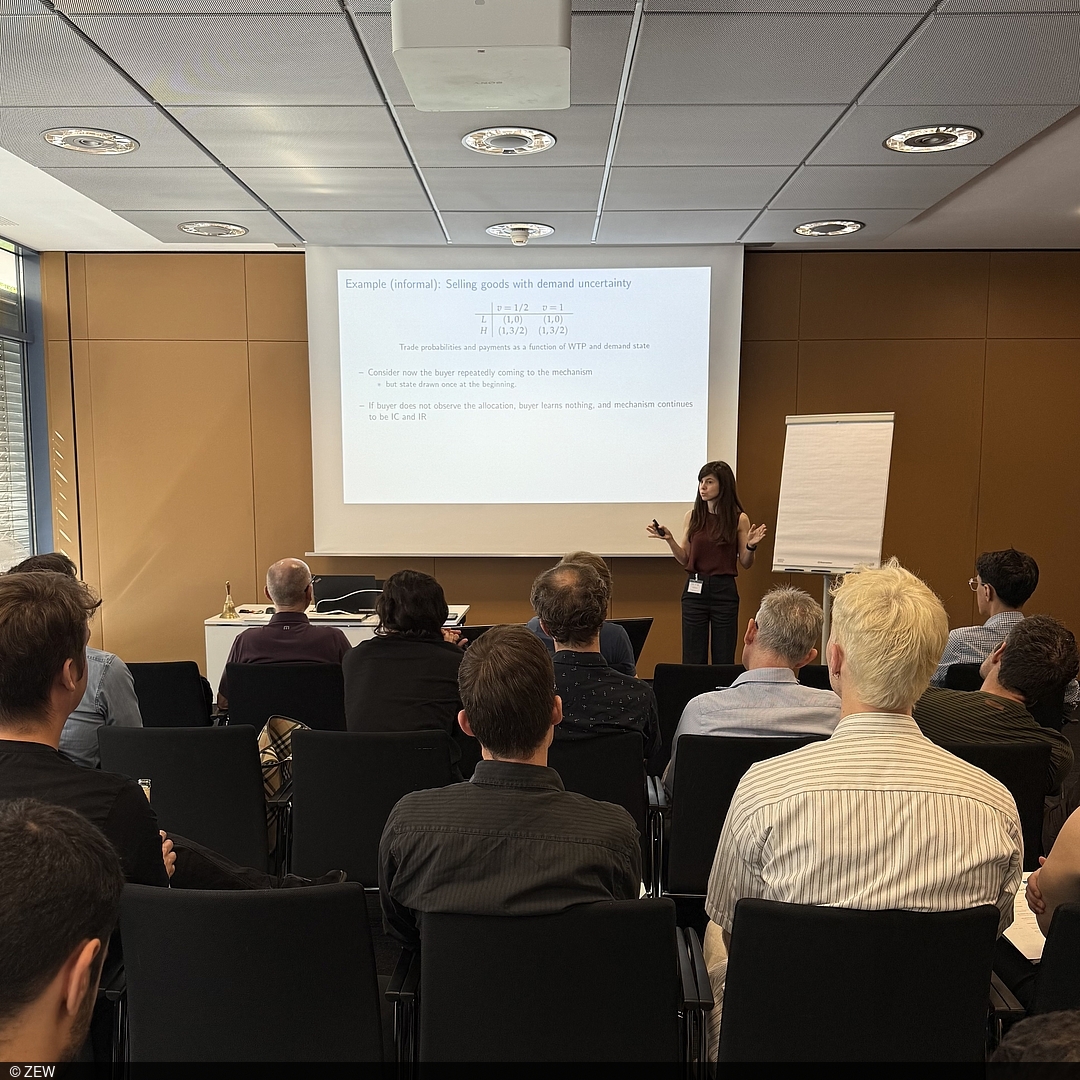
On 16 and 17 June 2025, ZEW organised the fifth edition of the European Workshop on Market Design in collaboration with ENS Paris-Saclay, Rice University, the University of Cologne and the University of Münster. The event brought together renowned international researchers in Mannheim to present their latest research on market design issues. Poster sessions also provided a platform for young researchers to showcase and discuss their work. This year's focus was on theoretical analyses spanning a wide range of applied and fundamental issues.
The conference opened with keynote presentations by Marco Ottaviani (Bocconi University Milan) and Laura Doval (Columbia Business School). Ottoviani examined what obstacles should ideally be imposed on applicants – for example, when applying for a patent or research funding – taking into account application costs and chances of success. Laura Doval explored the question of what results a mechanism designer can achieve when equipped with private information and dealing with learning agents who repeatedly participate in the mechanism, such as auctions for online advertising.
Research on language, misinformation and platform strategies
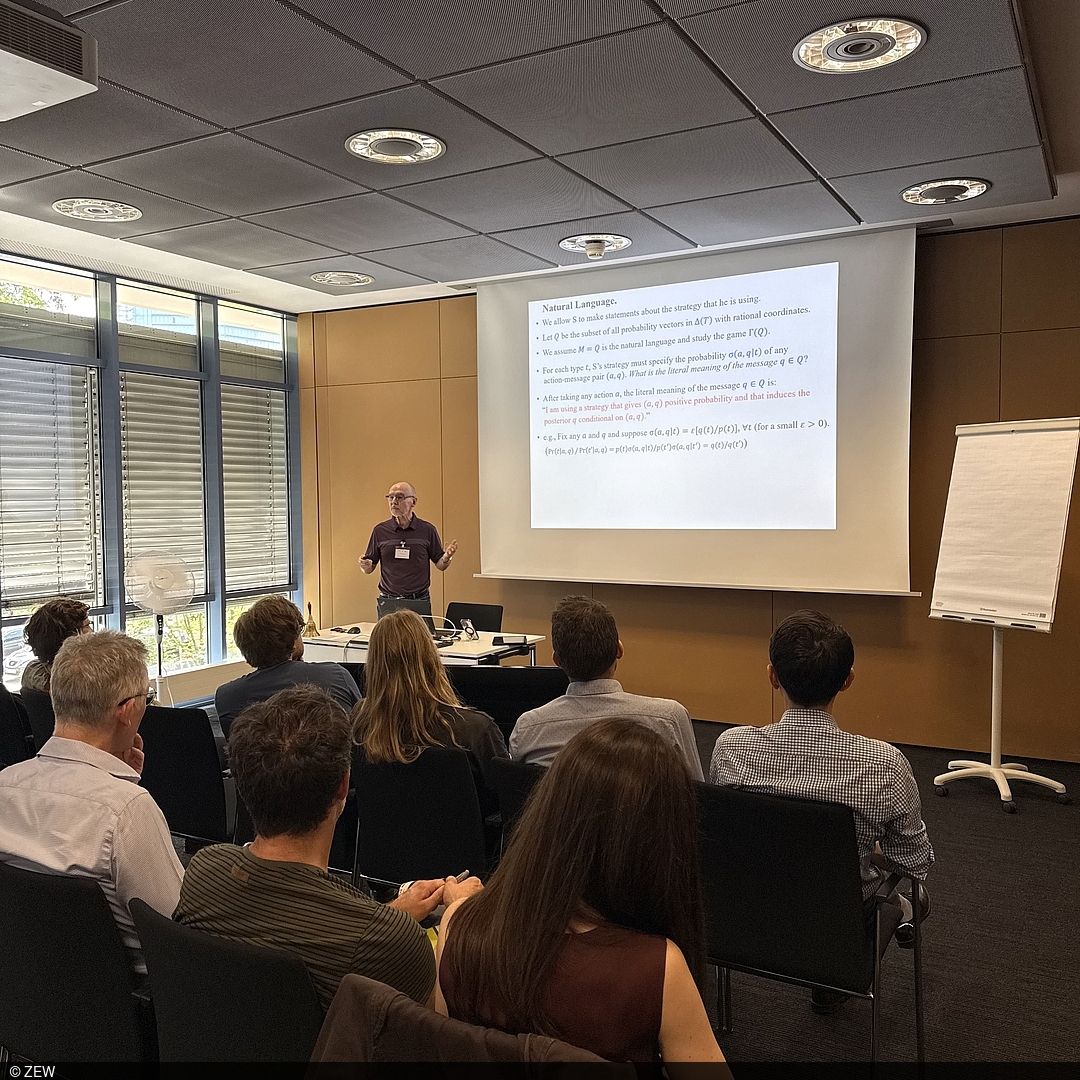
The first day of the event continued with presentations on various aspects of market design: Phil Reny (University of Chicago) showed which role language can play at game-theoretical analysis. Francisco Poggi (University of Mannheim) examined the potential influence of subsequent admissions when misinformation is transmitted. Atabek Atayev (ZEW) dealt with the question of what price information a trading platform should give to potential buyers in markets with search costs, with a focus on maximising seller revenues.
During the poster session, participants engaged in lively discussions around contributions from Yulia Evsyukova and Daniel Linnenbrink (both ZEW and University of Mannheim), Cyril Rouault (ENS Paris-Saclay, CEPS), and Philip Zilke (University of Münster). The following questions were discussed:
- How do free partial data sets increase seller revenue in data sales?
- What bidding strategies can be expected in pay-as-bid auctions?
- How do transfer policies and support measures for certain population groups affect job allocation?
- How can investments in green projects be promoted through appropriate auctions?
In the evening, Thomas Mariotti (Toulouse School of Economics) gave a lecture in memory of Nora Szech, who co-founded the workshop in 2019.
Matching markets in the spotlight of day two
On the second day, three presentations focused on the design of matching markets – i.e. markets without monetary transactions. Karolina Vocke (University of Innsbruck), Vincent Meisner (HU Berlin) and Tina Danting Zhang (UC Davis) examined
- when the results of such markets should be considered stable,
- what role expectations about one's own performance play in behaviour – even if the market mechanism actually makes this superfluous for optimal outcomes, and
- how design requirements change when decision-makers do not maximise utility but strive for a satisfactory outcome.
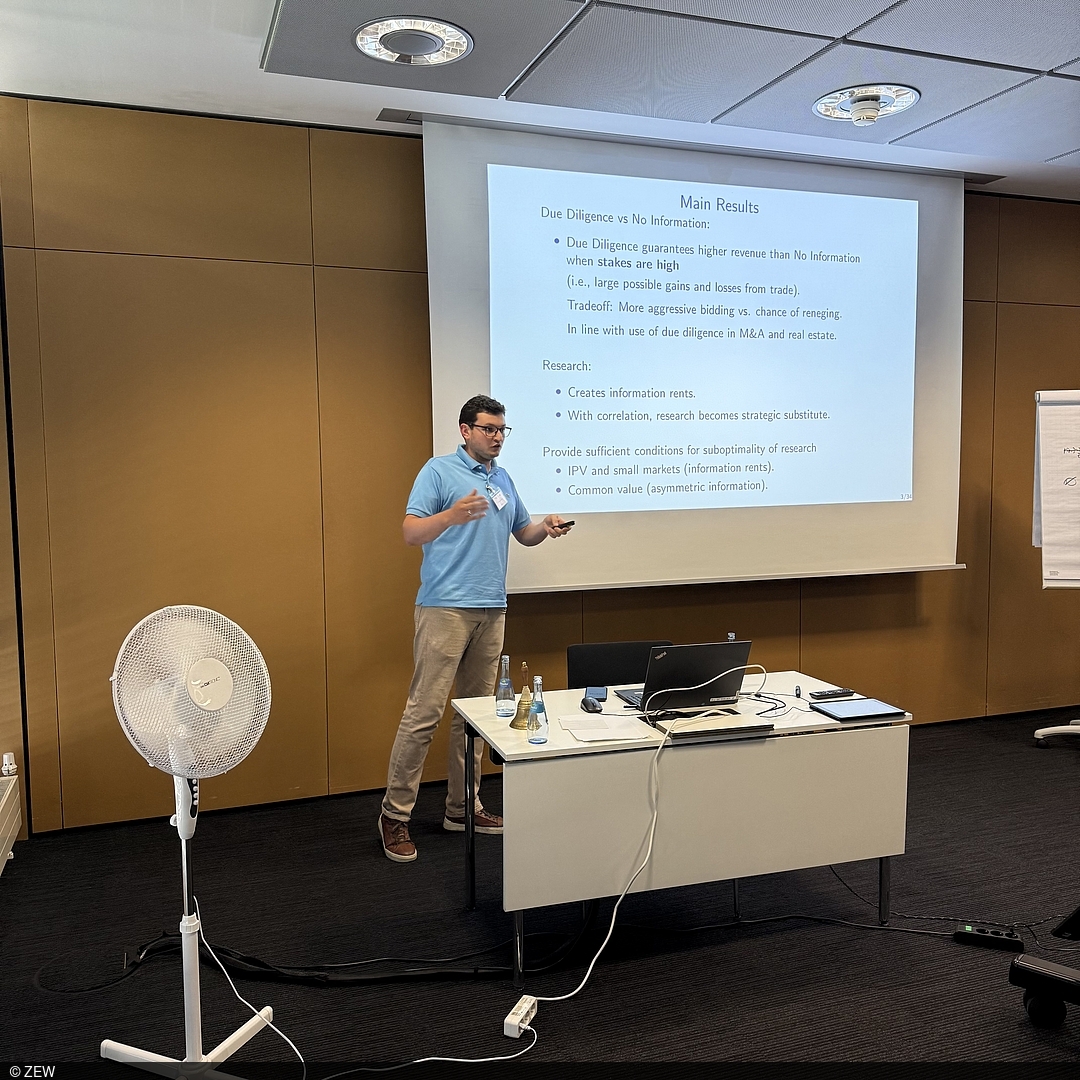
Ferdinand Pieroth (Yale University) demonstrated that in high-stakes auctions, it can be worthwhile to grant bidders access to information after the auction and to grant them a withdrawal right. Paula Onuchic (London School of Economics) identified incentives for disclosing proxies. Patrick Lahr (ENS Paris-Saclay) illustrated that mechanisms for the optimal allocation of multiple goods – for instance by a monopolist – must be carefully tailored to the specific problem and information structure.
The methodological proximity and thematic diversity fostered an intensive exchange between speakers and guests, making the workshop a rewarding experience for all participants.