“Germany Must Not Squander Opportunities”
EventsChairwoman of Council of Economic Experts Presents Annual Report at ZEW
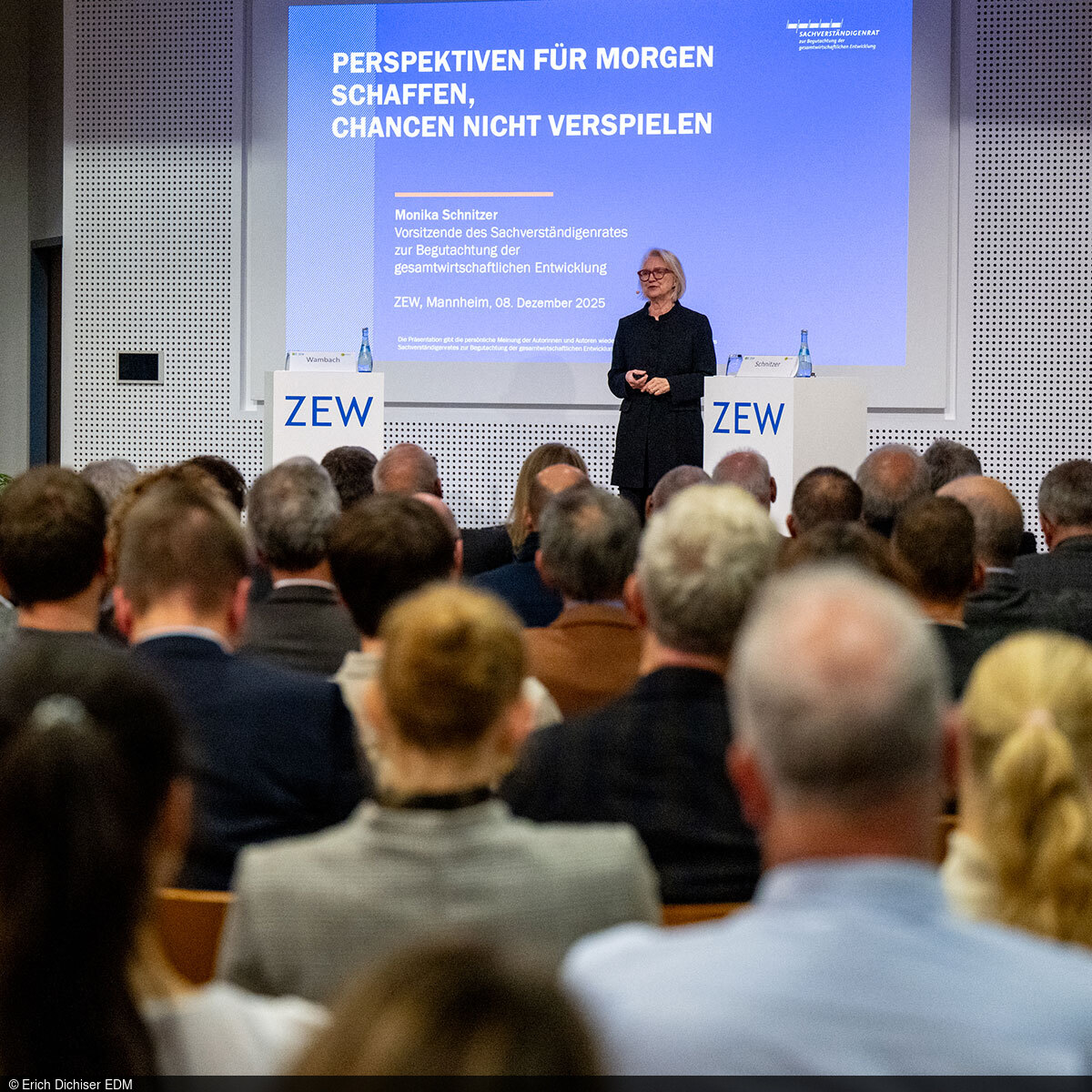
The German economy can only return to a growth path after two years of recession if productivity is increased, particularly through more innovation and investment. This was how Professor Monika Schnitzer, Chairwoman of the German Council of Economic Experts, summarised the situation when presenting the council’s 2025/26 annual report at ZEW in Mannheim. Around 200 guests attended the event on 8 December 2025 – part of the institute’s “First-Hand Information on Economic Policy” series – where she presented the council’s most comprehensive report to date and then discussed the challenges facing Germany as a business location in the coming years with ZEW President Professor Achim Wambach, PhD.


Schnitzer began her speech by explaining that the report was more comprehensive than it had been for decades because the German economy was currently struggling. No growth had been recorded since 2019, and the economy had even been in recession in the past two years. Despite a turn to plus 0.2 per cent economic growth in 2025, this was in fact stagnation. Growth in the entire euro area was 1.4 per cent.
Growth forecast no cause for celebration
Schnitzer said that the council forecast growth of 0.9 per cent for the next year but this was no cause for celebration as a third of the growth was due to the calendar effect (in 2026, many public holidays will fall on weekends, so there will be fewer days off work). A further 0.3 percentage points of growth could be attributed to the financial package, with the final third coming from genuine economic development.
Shortage of innovative German products
One of the main problems was that exports were not responding to the global economy, Schnitzer added. Negative special effects from US tariffs and sharply rising export prices due to an appreciating euro meant that many German products were no longer competitive. This could only partly be explained by high energy and labour costs: German exporters invested too little to be able to generate new innovations. Using the example of combustion engines, Schnitzer stated that the opportunities offered by technological change were not being utilised enough. With regard to the European market, she emphasised how its internal tariff regulations further weakened the position of companies.
Investment is a better growth driver than consumption
Schnitzer said that it was clear that something had to happen regarding Germany's infrastructure and defence situation. The financial package adopted by the Bundestag was an opportunity that should not be wasted. This is why the Council of Experts was calling for 85 per cent of the package to be spent on investment as this would double the growth effect and have a more positive impact on the debt ratio. However, when looking at actual and planned expenditure, it was noticeable that spending was mainly consumptive instead, which would generate only modest growth effects.
Nokia and Kodak as a warning
In the subsequent discussion with ZEW President Achim Wambach, Monika Schnitzer emphasised that Germany had not sufficiently prepared for demographic change and that the pension debate was heading in the wrong direction entirely. Companies, too, needed to embrace structural change rather than sticking to the tried and tested. She mentioned the example of Nokia and Kodak as a warning – companies that were once world market leaders and had disappeared into a niche or disappeared altogether. This could also be the fate of the German automotive industry.
Current inheritance tax not constitutional
On the subject of pensions and inheritances, Wambach questioned whether discussing an increase in the share of private capital in pensions as proposed by Schnitzer was not de facto an argument about hidden tax increases. At the same time, he questioned whether higher inheritance tax rates changed inheritance behaviour and how reliable the available studies were. Monika Schnitzer emphasised that her proposal was not about tapping into tax sources, but that inheritance tax was unconstitutional and created inequality, which was not the case with income tax. In her view, a higher inheritance tax was not a deterrent to building up wealth for future generations. Investing in the future, old-age provision and education was also a topic of interest for the subsequent Q&A session: A student from Mannheim's Bach-Gymnasium, where Monika Schnitzer had also completed her A-levels, wanted to know whether private old-age provision should be made more attractive. “Yes, absolutely,” she confirmed.
The fifth presentation of the annual report of the Council of Economic Experts by Monika Schnitzer at ZEW Mannheim took place with the kind support of the ZEW Sponsors' Association.