Digital Sovereignty: Companies Report Dependence on AI and Software
Information Economy
14.11.2025
ZEW Survey Reveals Dependencies in Key Technology Fields
A large share of companies in Germany perceive themselves as being highly reliant on non-European providers or partners in key technology fields. This is the finding of a representative survey conducted by ZEW Mannheim among approximately 1,100 companies in September 2025. Businesses in particular mention a strong dependency in the areas of software and generative artificial intelligence (AI) – even more so than in 2024 and 2021. Large companies are especially affected:
“Digital sovereignty is regarded as an essential requirement for the long-term competitiveness of companies as well as for the strategic independence of Germany and Europe. However, reliance on foreign – especially non-European – providers and partners can significantly limit companies’ digital sovereignty,” explains Dr. Daniel Erdsiek, study director from ZEW’s “Digital Economy” Research Unit. “Digital sovereignty generally refers to the ability to shape digital transformation independently with regard to hardware, software, services and skills. In terms of digital technologies and applications, it means being able to decide autonomously to what extent one wishes to rely on providers and partners.”
Dependence particularly strong in software and AI
In the information economy, more than 60 per cent of companies estimate that they are highly dependent on non-European providers or partners in at least one of the eight technology fields surveyed. In the manufacturing industry, this share amounts to just under 50 per cent.
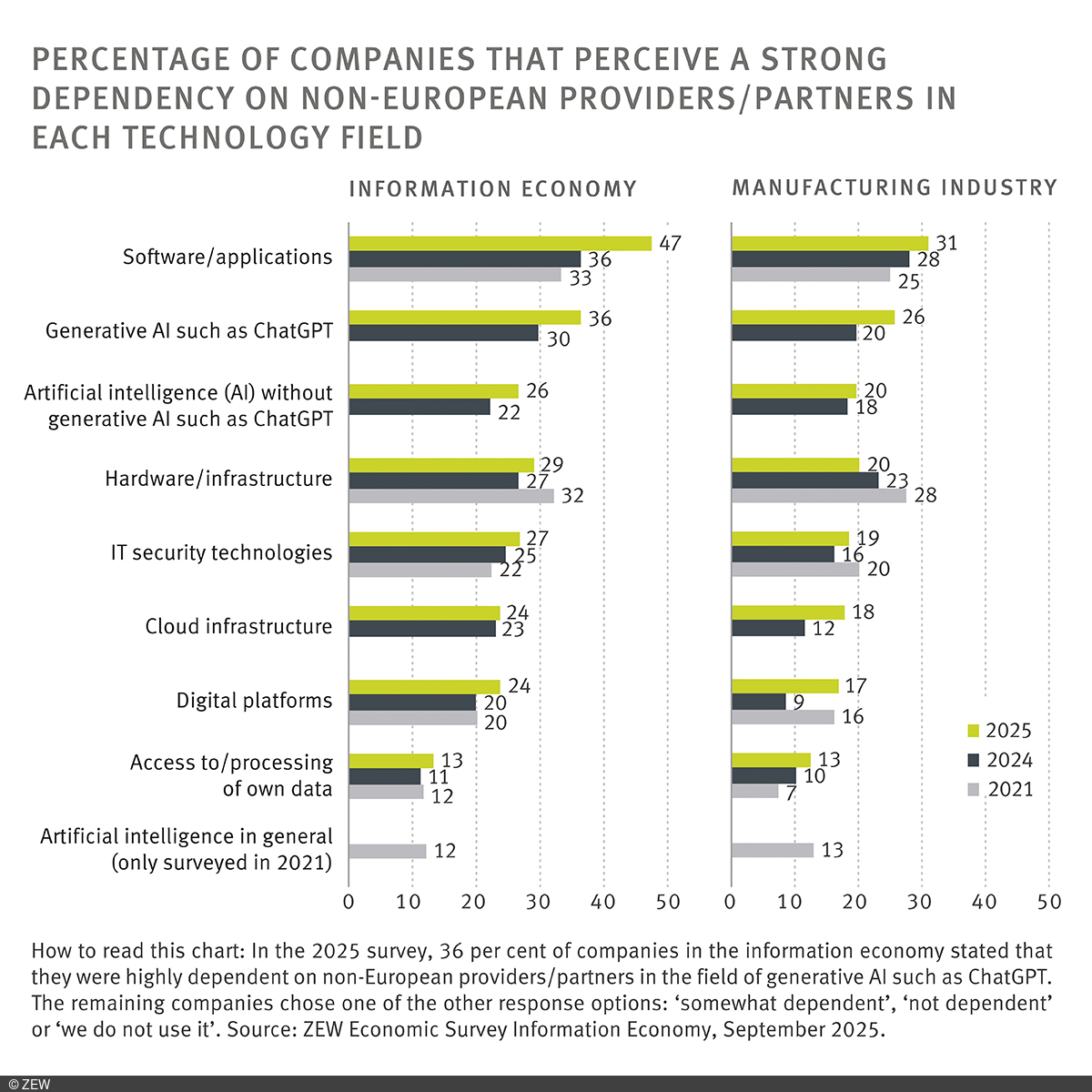
Companies most frequently report strong reliance in the field of software and applications (information economy: 47 per cent; manufacturing industry: 31 per cent). This share has increased over the last few years.
“When it comes to artificial intelligence, firms perceive dependencies particularly in the area of generative AI – such as ChatGPT. Here, more than one in three companies in the information economy and roughly one in four companies in manufacturing industry feel highly reliant on non-European providers. Compared to 2024, this share has risen by six percentage points in both sectors,” says Erdsiek.
Larger companies feel more dependent
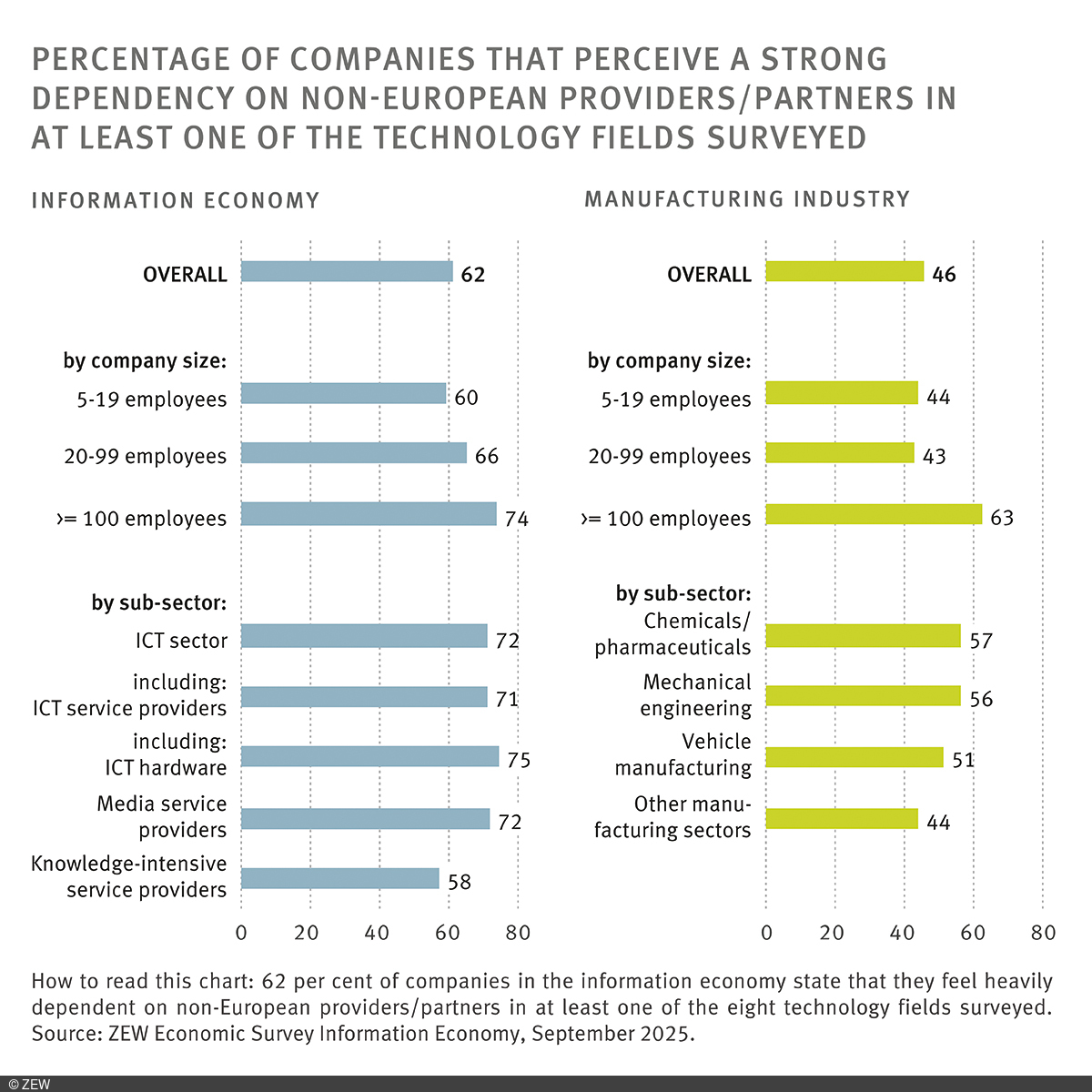
The share of companies that feel strongly reliant on non-European providers or partners in at least one of the eight surveyed technology fields is higher among larger firms. In the information economy, 60 per cent of small companies (5 to 19 employees) say they are very dependent, compared to 66 per cent of medium-sized firms (20 to 99 employees) and as many as 74 per cent of large companies (100 or more employees). In the manufacturing industry, 44 per cent of small companies and 63 per cent of large companies report strong dependencies.
“However, when interpreting differences by company size, it is important to note that these are subjective assessments of potential dependencies. Smaller firms may in fact be just as reliant on non-European providers as larger ones but may be less aware of such dependencies. This could be because they are less frequently in direct contact with such providers or less able to recognise indirect dependencies,” explains Erdsiek.
1,100 companies questioned on digital sovereignty
The data from September 2025 were collected as part of the ZEW Information Economy Report. For this purpose, the researchers surveyed around 1,100 companies in Germany. The participants are companies from the manufacturing industry and the information economy, which compromises the ICT sector as well as media service providers and knowledge-intensive service providers.