A Significant Rise in Firm Closures
ResearchNearly 190,000 Businesses Closed in Germany in 2025

The number of firm closures in Germany increased significantly for the second consecutive year, data for 2025 show. According to calculations by ZEW Mannheim and Creditreform, almost 190,000 businesses closed – around ten per cent more than in the previous year. The number of closures rose particularly sharply in the hospitality sector, the vehicle manufacturing industry and among medical practices. It is noteworthy that only one in eight firm closures is due to insolvency. Increasingly, even companies with medium or good credit ratings are voluntarily ceasing their business activities. Alongside economic difficulties, the closures are also attributable to a shortage of skilled labour, high costs and firms lacking successors.
“The renewed rise in closure rates shows that German businesses are increasingly under pressure to adapt. Uncertain operating conditions, high energy and personnel costs and the skills shortage are now affecting firms across almost all sectors of the economy,” explains Dr. Sandra Gottschalk, researcher at ZEW’s “Economics of Innovation and Industrial Dynamics” Research Unit. “At the same time, demographic trends are becoming increasingly significant. More and more companies are closing because their owners are retiring and cannot find a successor, even though these businesses would otherwise be viable.”
“The number of businesses leaving the market is rising significantly. Large companies and corporate groups are currently dominating the news. However, the number of small and medium-sized enterprises that are quietly disappearing is many times greater,” says Patrik-Ludwig Hantzsch, press spokesperson for Creditreform in Neuss. Hantzsch goes on to report that even companies with a good or at least average credit rating are now having to close down.
Hospitality sector and medical practices are particular affected
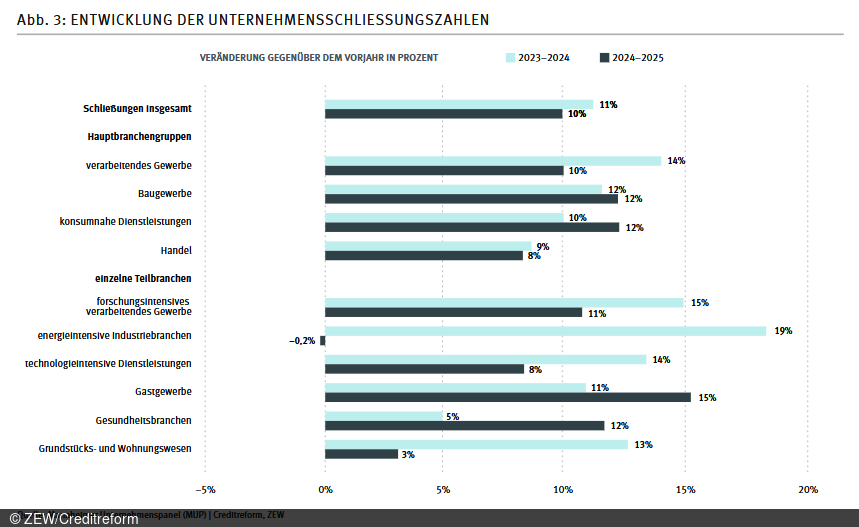
In the hospitality sector, around 15,000 businesses were closed in 2025. This represents a 15% rise on the previous year and is the highest increase among the sectors examined. High personnel and operating costs, as well as difficulties in recruiting staff and skilled workers, are placing a particular strain on smaller businesses.
The number of closures in the health care sector rose by 12% to almost 11,000 firms. The trend among doctors’ practices is particularly striking: Nationwide, nearly 5,500 practices were closed, 23% more than in 2024. This trend has been evident for several years now and is likely to be linked to the retirement of many practice owners and a lack of successors.
Only one in eight closures is due to insolvency
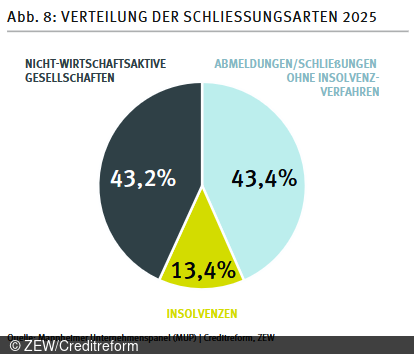
Of the business closures recorded in 2025, no more than around 13% were due to insolvency proceedings. Around 86% were divided equally between deregistrations and business closures without insolvency proceedings, and businesses that were classified as no longer economically active.
Demographic trends, too, are gaining in importance: Among owner-managed family businesses, around 29% of those that closed voluntarily in 2025 had owners aged 65 or over. In 2002, this proportion had stood at just 14%.
About the methodology
The analysis is based on the Mannheim Enterprise Panel with data provided by Creditreform and maintained by ZEW Mannheim. The dataset contains information on more than nine million firms, around three million of which are currently economically active. Microenterprises, self-employed persons and freelancers are also represented in the dataset. The data include information on insolvencies, deregistrations, registered closures – attributed to Creditreform’s own investigations – as well as statistical estimates of the number of firms that ceased operations.