“Future World of Work” Research Prize Awarded
AwardsVolksbank Kurpfalz Stiftung and ZEW Mannheim Honour Young Scientists
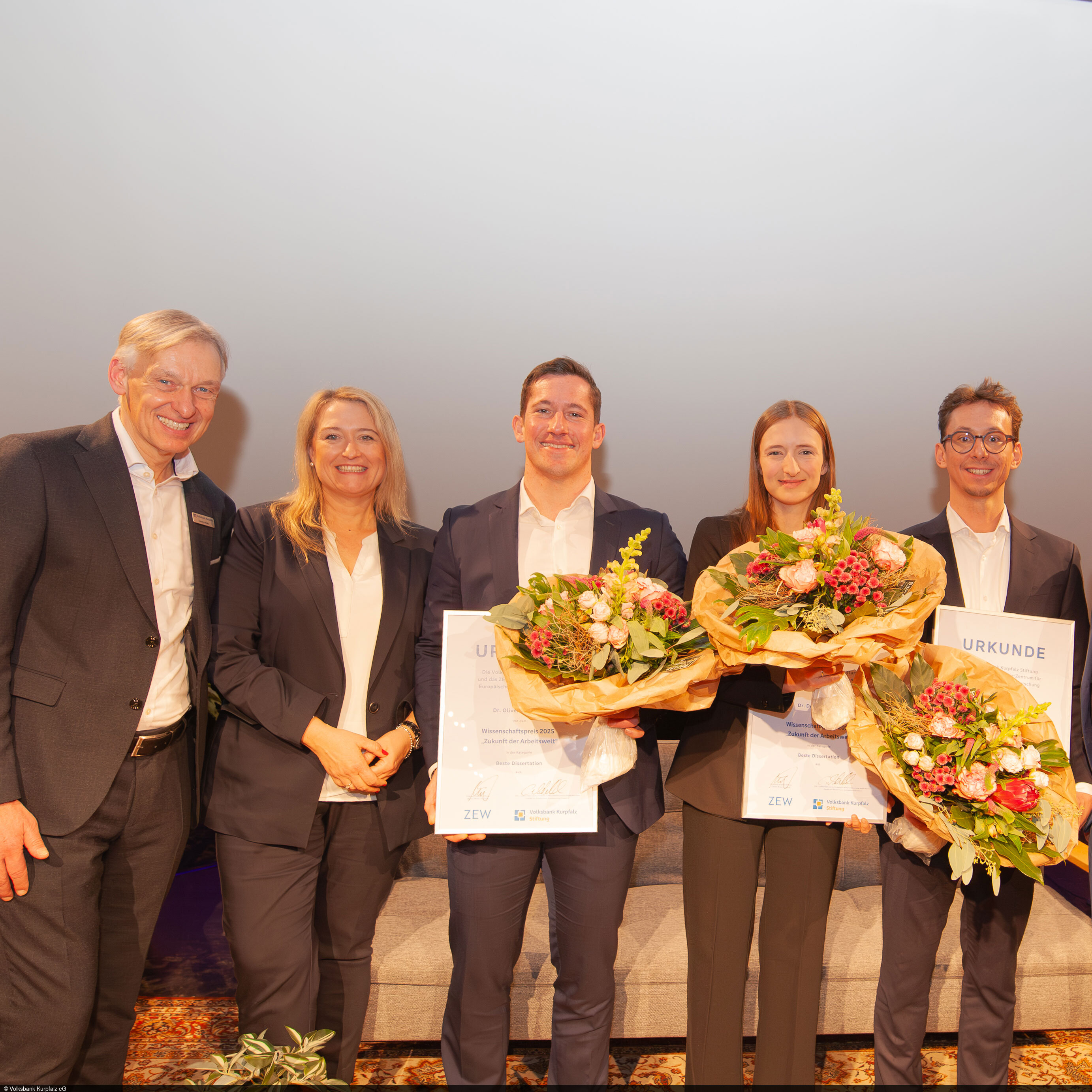
Yesterday, the foundation Volksbank Kurpfalz Stiftung and ZEW Mannheim awarded the ‘Future World of Work’ research prize for the thirteenth time. This year, for the first time, the prize was awarded to two outstanding dissertations and one master's thesis in economics, each from the Rhine-Neckar metropolitan region. Due to the large number of excellent submissions, the jury decided to award two prizes for the best dissertation, which went to Deborah Mateja and Oliver Schlenker. The prize for the best master’s thesis was awarded to Simon Hohnwald. In her laudatory speech, Claudia von Schuttenbach, Managing Director of ZEW, referred to the exceptional problem-solving orientation and strong societal relevance of the award-winning works, which could also have a major impact on political debates.
“We are delighted that our cooperation with ZEW enables us, alongside our strong commitment to the non-profit sector, to specifically support young researchers through this research award. These young scientists make important contributions to the development of our working world through their work. We would like to thank everyone who works behind the scenes on this research award, in particular the jury, which demonstrates a high level of expertise and great commitment in selecting the award winners year after year,” explains Carsten Müller, Chairman of the Volksbank Kurpfalz.
Claudia von Schuttenbach emphasises: “For us, the winning works stand out above all for their high level of innovation. And what makes them even more special is that they are not just dry theories. Here, relevant research has been put directly into practice. This works perfectly with the aims of this research award.
Impact of AI on creativity
Deborah Mateja's dissertation, “Creativity and Artificial Intelligence: Conceptual Foundations, Design, and Use,’ examines how artificial intelligence supports, expands and changes creative processes in three interdisciplinary studies. The work shows that AI can develop independent creative abilities – especially in the generation of new ideas – while remaining dependent on human goal-setting, evaluation and contextual understanding. The dissertation provides practical evidence of how AI can democratise creative activities such as design and innovation, while also providing evidence-based guidelines for the design of human-AI collaboration. The work was completed at the University of Mannheim and awarded 2,000 euros.
Technological change decides
Oliver Schlenker’s doctoral thesis “Three Essays on Contemporaneous Challenges in the Labour Market,” written at the University of Konstanz, analyses the social and health-related consequences of digitalisation, automation and labour market regulation in three empirically based studies. The research shows that shortages of nursing staff lead to measurably higher mortality rates, that works councils help to socially cushion technological change while also strengthening productivity and that digital work increases psychological pressure, particularly for low-skilled workers. It thus makes clear that technological progress has not only economic but also health-related and societal effects and that it requires active, cooperative governance. During his doctorate, Schlenker worked at ZEW in the “Labour Markets and Social Insurance” Research Unit. His award is also endowed with 2,000 euro.
The future of the European market for end-of-life vehicles
Simon Hohnwald also receives 2,000 euro for the best master's thesis. In his final thesis in Business Administration at the University of Mannheim, entitled “The European End-of-Life Vehicle Market: Status Quo, Outlook, Consumer Perspectives, and Implications for Sourcing Strategies,” he analyses the European end-of-life vehicle market and explores ways towards a circular automotive economy. Produced in cooperation with Porsche Consulting, the thesis is the first to examine the regulatory, industrial and consumer-related dimensions of vehicle recycling.
Based on a representative survey and machine learning methods, the work identifies four key user personas and shows that alongside financial incentives, trust and transparency are crucial for the return of end-of-life vehicles. The results of the thesis are currently being incorporated into ongoing consulting projects and are therefore already contributing to the green transformation of the industry.
About the Award
Since 2013, the “Future World of Work” research award has been granted by Volksbank Kurpfalz Stiftung and ZEW to honour young economists in the region. The prize is awarded for outstanding dissertations and master’s theses in the field of economics that have been written at a university or non-university research institution, in particular in the Rhine-Neckar metropolitan region. The deciding factors for the award are academic excellence, practical relevance, a strong empirical focus, high utility through innovative problem-solving, and the originality of the topic.
A jury is responsible for selecting from the numerous submissions. This year, the research award is endowed with 2,000 euro. Both awards come with the opportunity for a research stay at ZEW and are presented at an annual ceremony.