Hybrid Working Models to Remain in Demand in Future
Information EconomyZEW Survey on the Information Economy and Manufacturing Sector

Over the next two years, only few companies in Germany plan to scale back their existing work-from-home arrangements, neither regarding the frequency of working from home nor the proportion of staff doing so. A recent representative survey by ZEW Mannheim of around 1,400 companies in the information economy and manufacturing sector reveals which hybrid models they intend to use in future and to what extent.
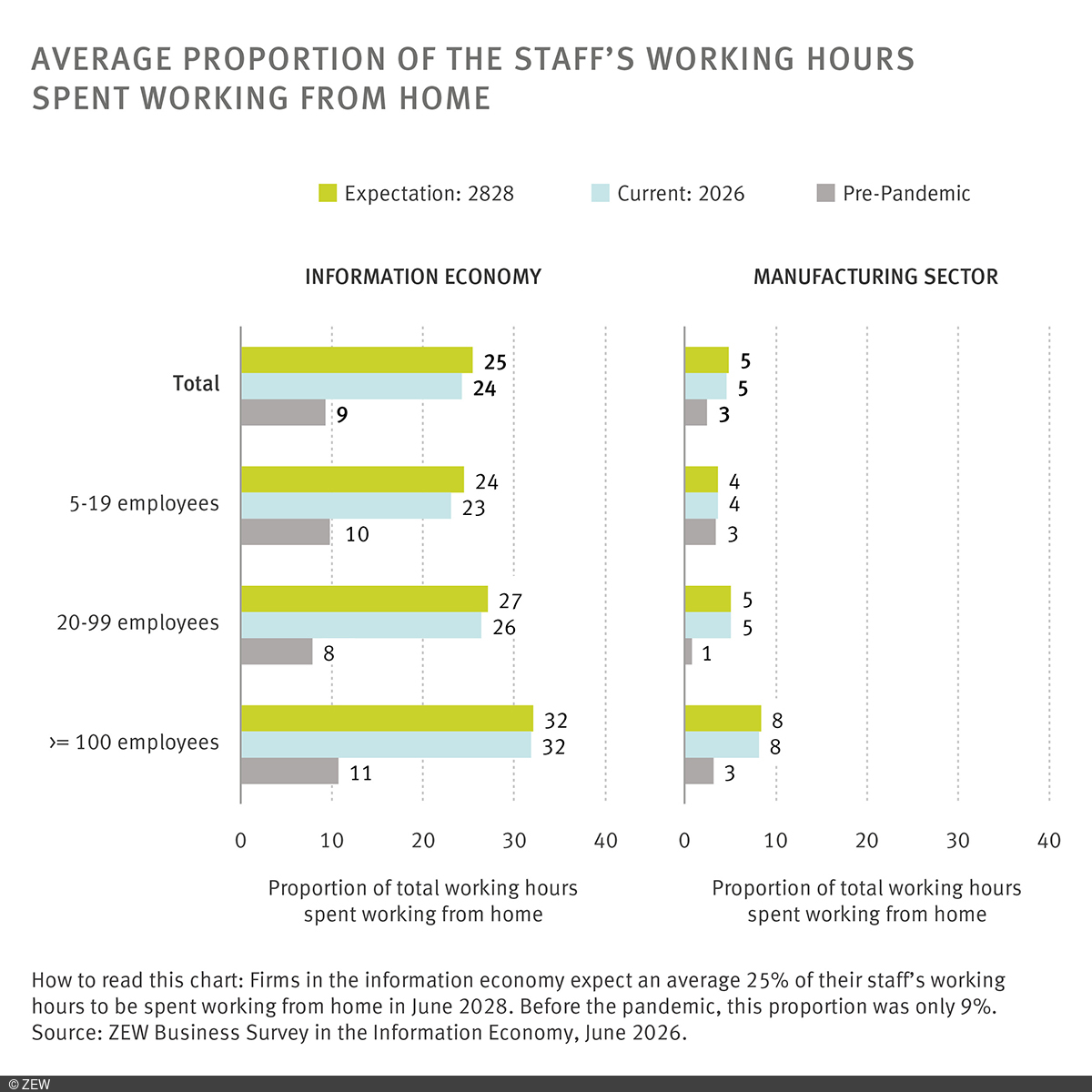
On average, firms in the information economy report that around a quarter of their staff’s working hours are spent working from home. They expect this proportion to remain the same over the next two years. In the manufacturing sector, which is more location-dependent, the current and expected proportion, meanwhile, stands at an average of 5% of working hours.
“The COVID-19 pandemic has led to a permanent change in working practices across large parts of the economy where the nature of the work permits it. The proportion of work carried out from home has almost tripled in firms in the information economy and in the manufacturing sector it has almost doubled. From the firms’ perspective, this is not set to change in the next two years,” says Dr. Daniel Erdsiek, director of the study and member of ZEW’s “Digital Economy” Research Unit.
Many firms offer work-from-home arrangements
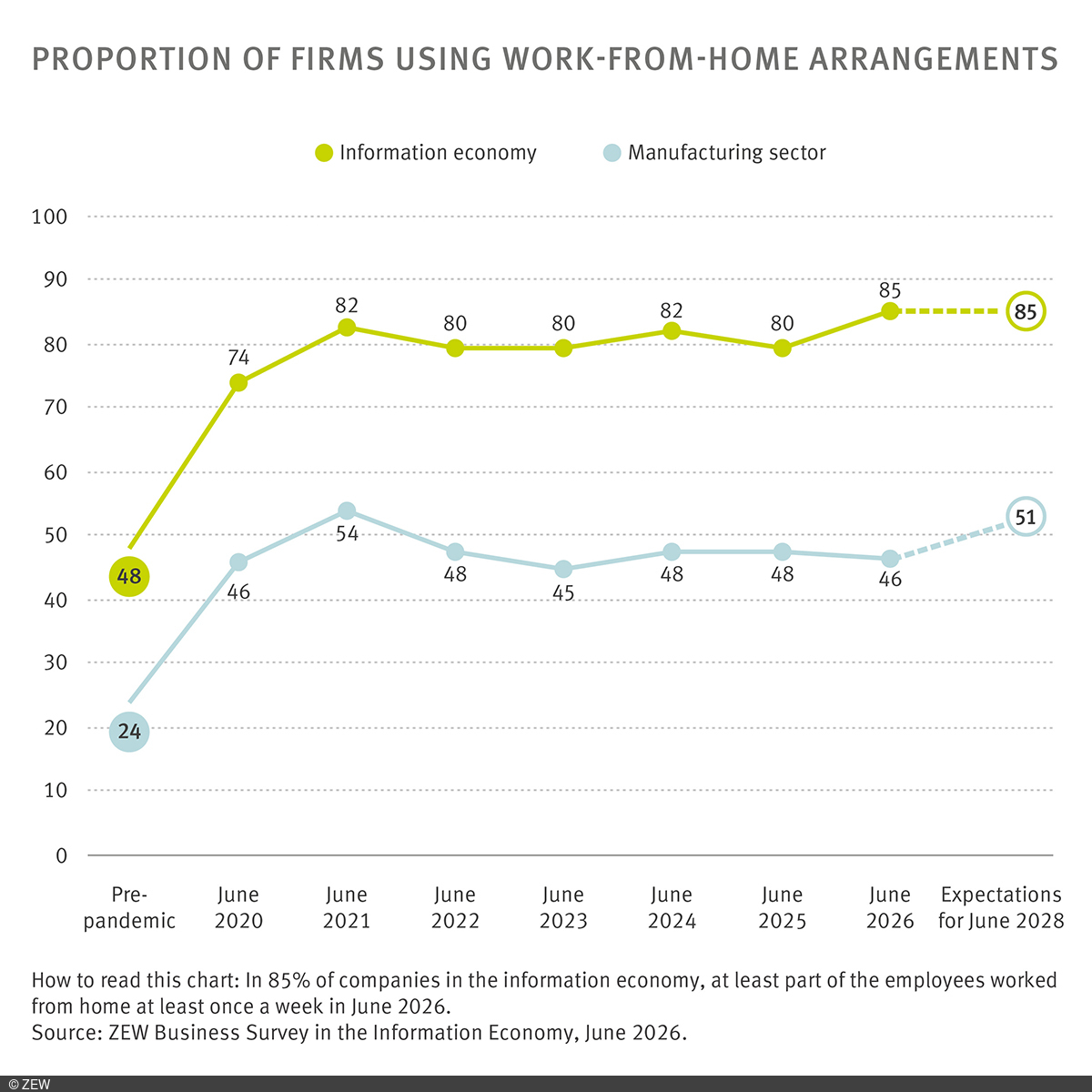
Working from home for at least one day a week is currently possible in 85% of companies in the information economy. Such arrangements are now more widespread than they were during the pandemic.
Hybrid models involving at least two days of home working per week are in place in two-thirds of companies, and around half of companies allow at least three days of remote work per week.
Work in the manufacturing sector is often location-dependent, so remote working options are less common there. Approximately one in two companies offers working arrangements with at least one day of remote work per week, while arrangements with two or more days of working from home are in place in 30% of companies.
Differences according to company size
“It is not only the sector but also the size of the company that determines the extent of work-from-home arrangements. The larger a company is, the more it tends to allow working from home,” says Erdsiek. “For example, in large companies in the information economy, around a third of working hours are currently spent working from home. In small firms, the share is only around a quarter. In the manufacturing sector, the proportion ranges from 8% for large companies to 4% for small companies.”
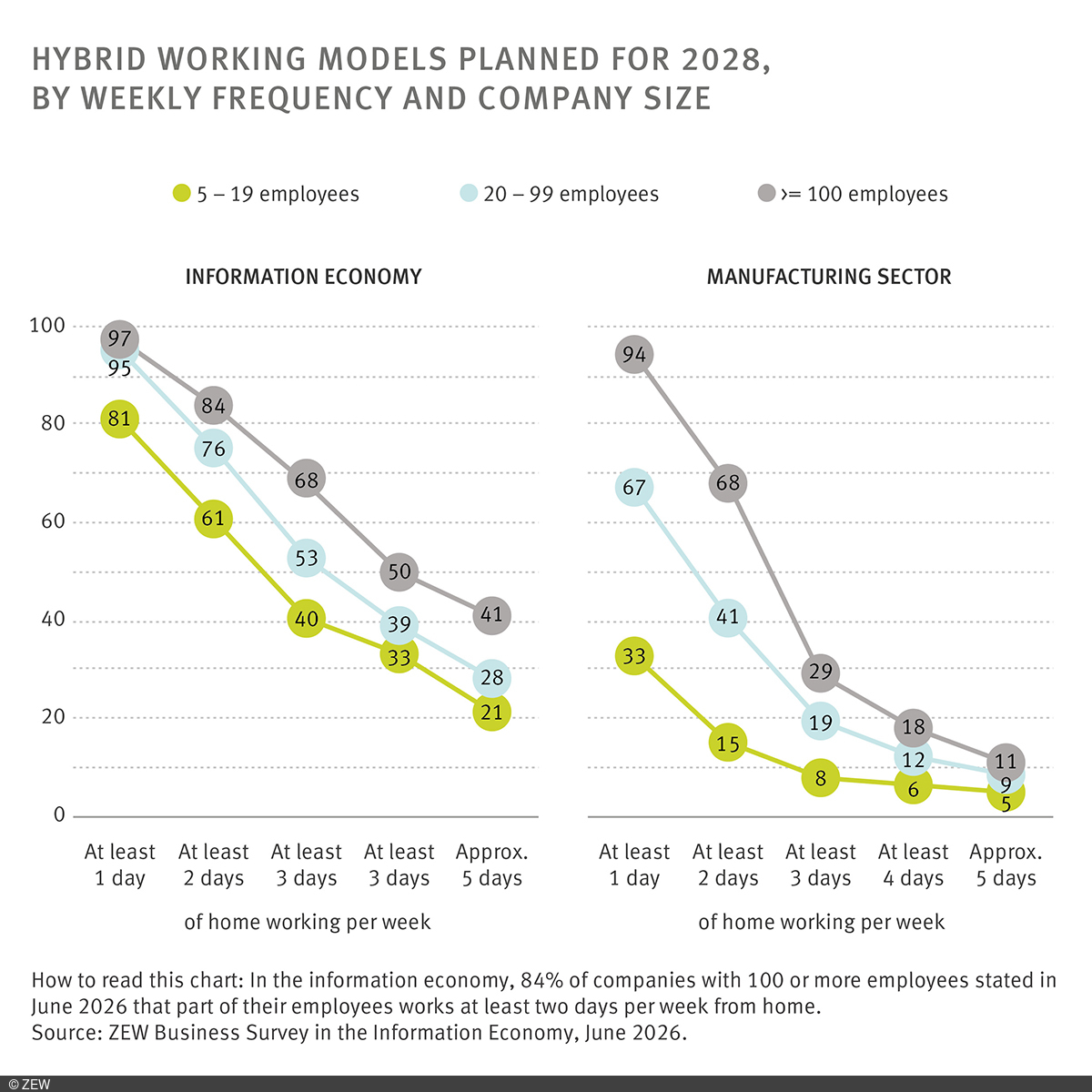
These differences in the use of multi-day work-from-home arrangements will persist over the next two years. In the information economy, 84% of large firms, but only 61% of small firms plan to implement models that provide for at least two days of working from home. Working models with at least three days of remote working are planned by 68% of large companies and 40% of small companies. In the manufacturing sector, differences based on company size are particularly pronounced for models involving at least one or at least two days of working from home.
Around 1,400 companies surveyed
The June 2026 data was collected as part of the ZEW Sector Report for the Information Economy. For this purpose, the researchers surveyed around 1,400 companies in Germany. The participants are companies from the manufacturing sector and the information economy, which comprises the ICT sector as well as media service providers and knowledge-intensive service providers.