AI as a Critical Competitiveness Factor
Information EconomyZEW Survey in the Information Economy and Manufacturing Sector

AI applications increasingly find their way into the world of work and thus contribute to the transformation of the economy. Many firms in Germany expect Artificial Intelligence (AI) to have a major impact on their competitiveness in the years ahead, with large companies in particular considering the technology to be highly relevant. CEOs’ expectations also depend on their own use of AI. These are the findings of a recent representative survey conducted by ZEW Mannheim among around 1,300 companies in Germany’s information economy and manufacturing industry.
“AI can help companies to streamline their work processes or further develop their products and services, which is why many firms expect AI to play an important role in securing a competitive edge. The CEOs’ view of the future significance of AI can shape the strategies they adopt to promote the use of AI within their own organisations,” says Dr. Daniel Erdsiek, director of the study and member of ZEW’s “Digital Economy” Research Unit.
Information economy firms rate AI as more important than manufacturers do
Currently, 46 per cent of firms in the information economy, which comprises the ICT sector as well as media service providers and knowledge-intensive service providers, expect AI to be crucial to their competitiveness in the next three years. A further 28 per cent of firms regard the role of AI as important. By contrast, only one in ten companies in the information economy views AI as irrelevant or of minor importance.
In the manufacturing sector, a considerably higher proportion of firms – 30 per cent – believe that AI will have little or no impact on their future competitiveness. Nevertheless, even in this sector, the proportion of companies expecting AI to have a (very) important impact still predominates (47 per cent).
AI has greater importance for larger companies
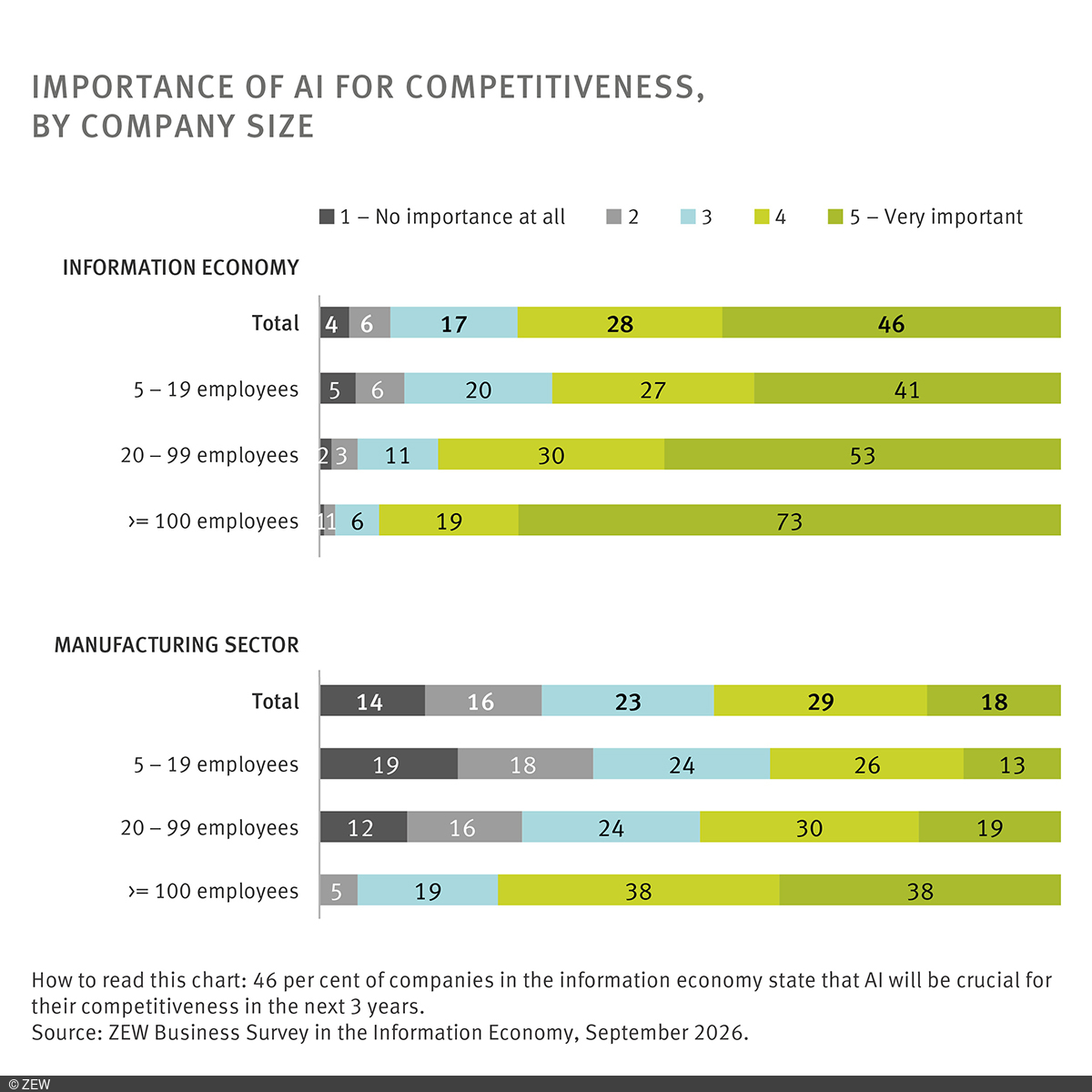
Large companies, i.e. firms with at least 100 employees, are more likely than smaller ones to see AI as (very) important for their competitiveness. In the information economy, almost three-quarters of large firms expect AI to play a very important role, while a further 19 per cent anticipate it will play at least an important role. Just two per cent of companies of this size believe that AI will not be important.
CEOs’ use of AI is crucial for expectations
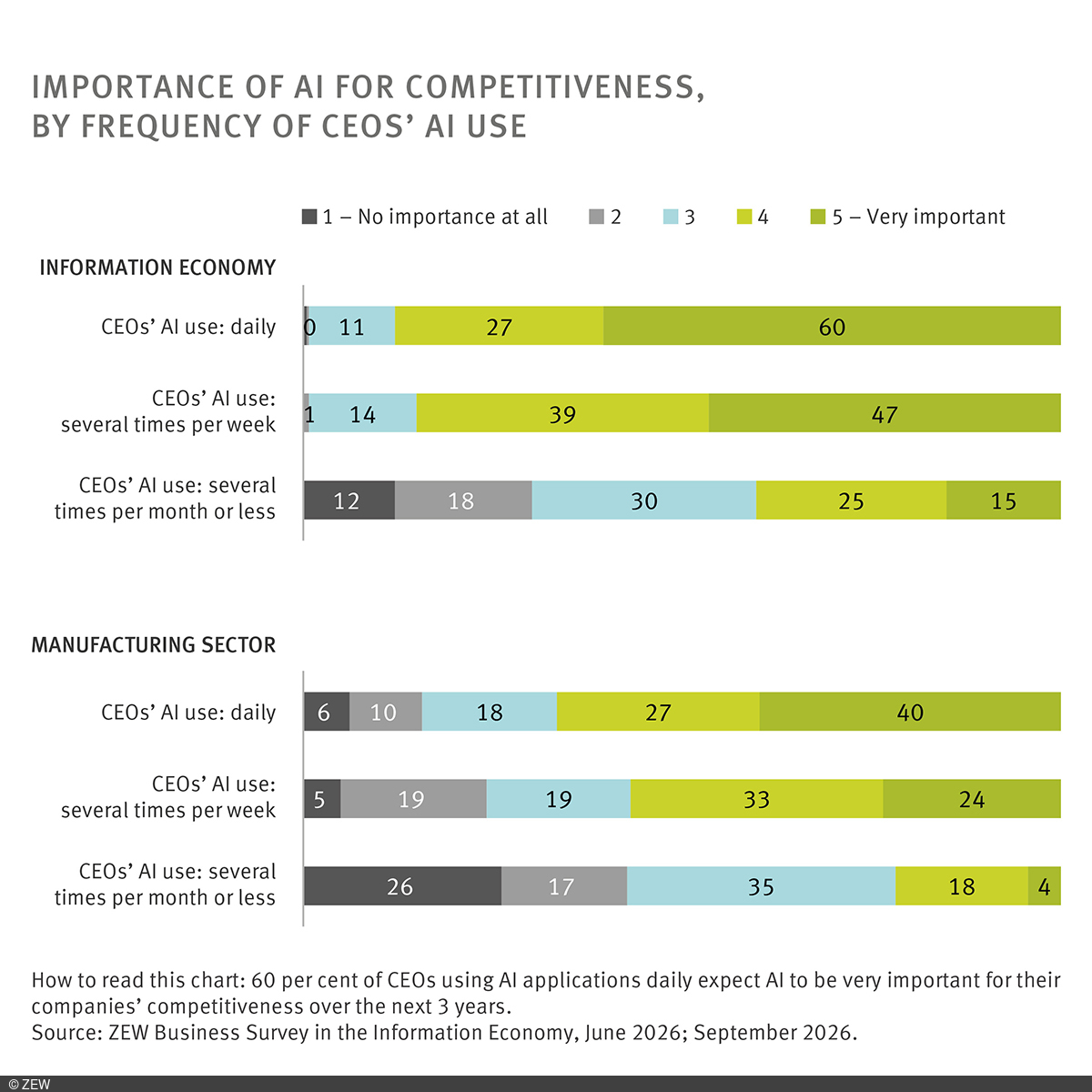
CEOs’ expectations also depend on how frequently they themselves use AI. The more often executive managers use AI applications, the more likely they are to see that the link between AI and competitiveness will be relevant in the next three years,” says Erdsiek.
In the information economy, for example, around 86 per cent of CEOs who use AI applications daily or several times a week consider this link to be (very) important. Among executive managers who use AI less frequently, this proportion is only 40 per cent. In the manufacturing sector, the same trends can be observed depending on the CEOs’ use of AI, although firms generally regard the role of AI as less relevant than in the information economy.
Around 1,300 companies surveyed
The data from September 2026 were collected as part of the ZEW Business Survey in the Information Economy. For this purpose, the researchers surveyed around 1,300 companies in Germany. The participants are companies from the manufacturing sector and the information economy, which comprises the ICT sector as well as media service providers and knowledge-intensive service providers. The use of AI by executive managers was surveyed in the June 2026 survey wave. The data of each participating company was linked with the data from the September 2026 survey.