Green Financial Intermediation
Financial Intermediation and Its Role in the Green Transformation
How can the financial sector effectively support the transition towards a more eco-friendly economy? In the INTERACT project, carried out jointly with the ifo Institute – Leibniz Institute for Economic Research at the University of Munich, a team from the ZEW Research Unit “Pensions and Sustainable Financial Markets” investigates how capital flows can be directed effectively towards sustainable investments. The project analyses all steps of green financial intermediation – from private investor demand and regulatory measures to climate impact. Initial findings show: ESG ratings and financial knowledge are key drivers, and green bonds can encourage banks to lend in a more climate-friendly way. The project is funded by the Federal Ministry of Research, Technology and Space (BMFTR).
(Youpeng Zhang, Tabea Bucher-Koenen, Bennet Janssen and Karolin Kirschenmann (from left to right))

Financial Markets and Climate Targets: Where Do We Stand?
What is the INTERACT project about?
INTERACT analyses the entire impact chain of sustainable financial flows – from investor demand and financing mechanisms to measurable climate impacts. The project’s aim is to better understand the channels through which the financial sector is actually contributing to the transition and to identify existing gaps.
Is the financial sector’s current commitment sufficient?
The project results suggest that much remains to be done. Most importantly, it is uncertain what mechanisms are most effective in channelling capital into sustainable investments. This is precisely where the project team’s research comes in.
Financial literacy and ESG ratings as key levers for retail investors
What role do retail investors play?
A key finding is that many households are largely unaware of sustainable financial products. In most cases, there is a lack of the basic knowledge needed to integrate sustainability goals into investment decisions. Financial literacy, especially with regard to sustainable investments, is therefore a crucial lever.
At the same time, we see that the majority of equity investors are investing in sustainable funds. ESG ratings can promote sustainable investment. But if these ratings vary significantly from one another, confidence declines, and with it the willingness to invest.
Green bonds have an impact – but it is limited
How does capital find its way into sustainable projects?
Green bonds play an important role here. They encourage institutional investors to make sustainable investments and incentivise banks to grant loans that have a positive climate-related impact. Nevertheless, their impact is limited: Positive effects are primarily seen in companies that already have a relatively good sustainability record. For CO₂-intensive companies, these instruments have so far proved insufficient. To drive the transition forward on a broader scale, we need more targeted approaches.
Regulation: Reconciling impact and costs
How important is regulation?
Regulatory instruments such as the EU taxonomy or sustainability reporting are intended to steer capital flows. The project findings show that banks’ lending does indeed respond to regulation and that banks manage transition risks through appropriate contract design.
At the same time, the cost of compliance with reporting requirements is high – particularly for small and medium-sized enterprises, and also indirectly via supply chains. These costs are only justified if they actually lead to more sustainable investment. There is a need for evaluation and adjustment here.
Striking a balance between stability and further development
What does this mean for policymakers?
The key challenge is to strike a balance: Regulation must be further developed; market participants need stable and reliable framework conditions. Planning certainty is crucial, particularly for long-term investments.
The findings also underscore the importance of financial literacy. Sustainable transformation can only succeed if investors possess the necessary information and skills to make informed decisions.
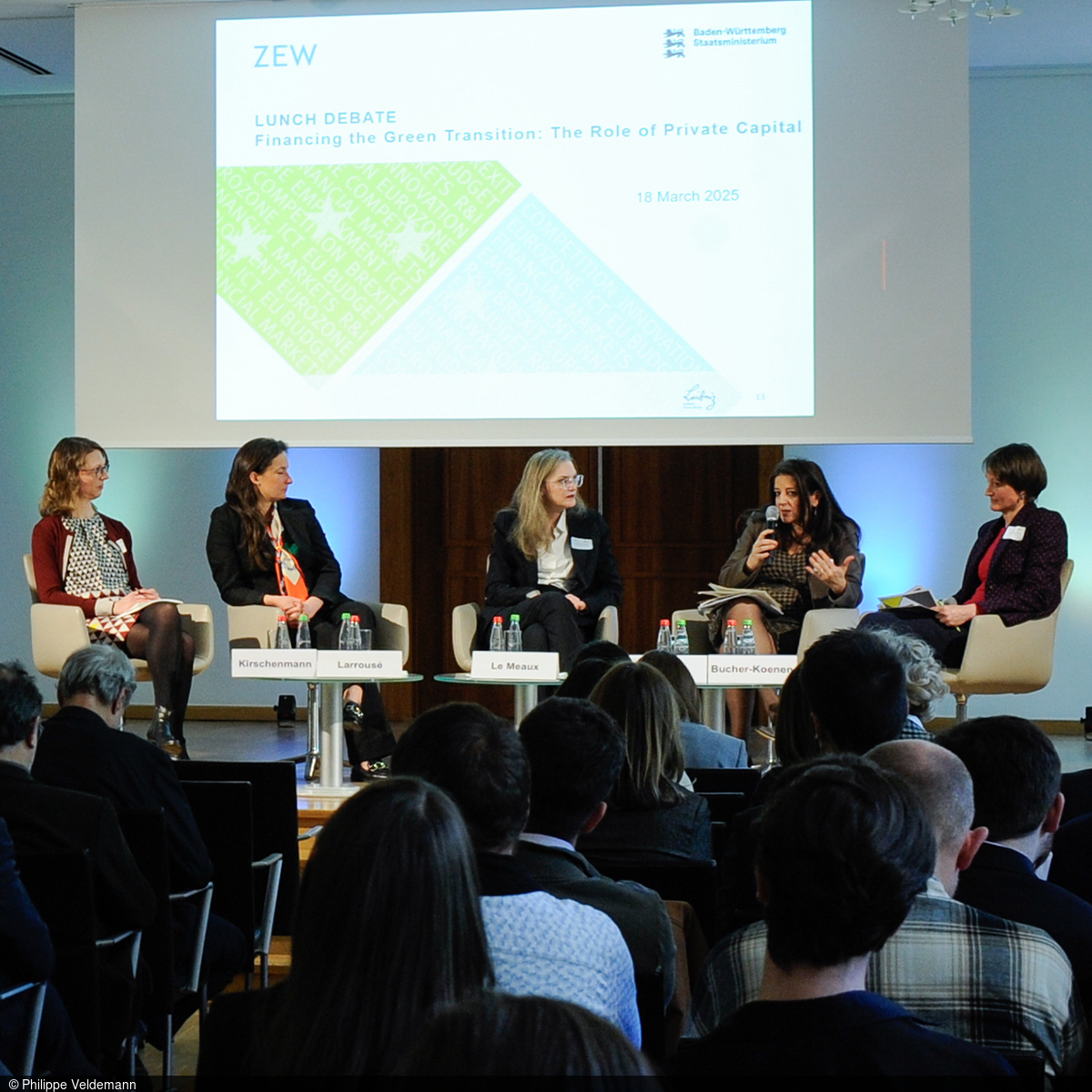
What Private Investors Need for the Green Transition
How can private capital be mobilised for the green transition? This was the central question posed at the ZEW Lunch Debate entitled “Financing the Green Transition: The Role of Private Capital”, which was hosted by the Representation of the State of Baden-Württemberg to the European Union in Brussels. Chaired by ZEW economists Professor Tabea Bucher-Koenen and Professor Karolin Kirschenmann, a panel explored the drivers and barriers for private and institutional investors to engage in financing the green economy and discussed regulatory frameworks for capital markets.
More information
Impact Award for ZEW Economists
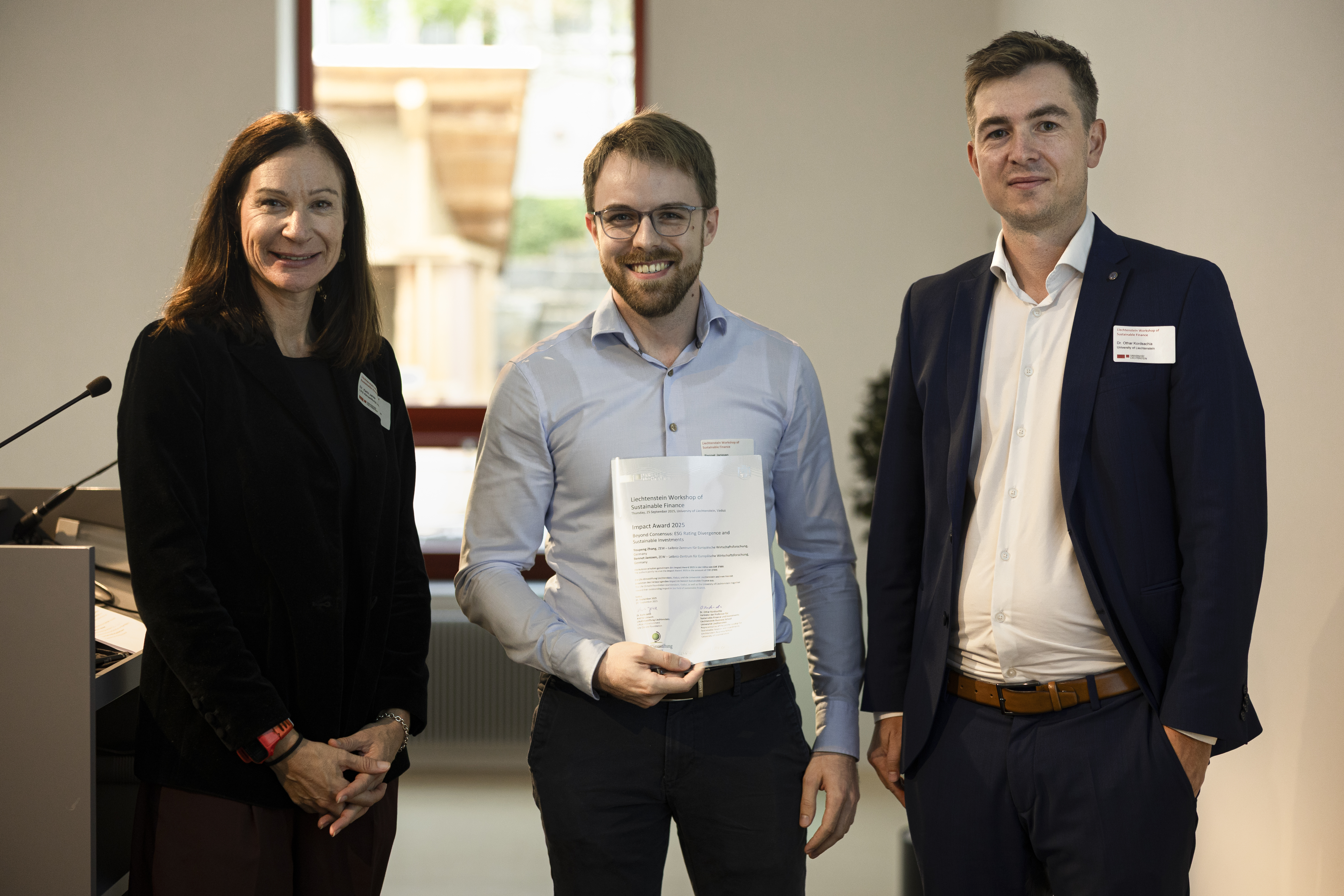
ZEW economists Bennet Janssen and Youpeng Zhang received the Impact Award of the LIFE Climate Foundation Liechtenstein at the Liechtenstein Workshop of Sustainable Finance 2025.
Their study, which is based on a survey of over 2,000 private investors in Germany, shows that a strong divergence in ESG ratings by different rating providers reduce investors’ willingness to invest in sustainable funds.

Pensions and Sustainable Financial Markets
The “Pensions and Sustainable Financial Markets” Research Unit analyses the challenges to pension systems and the financial sector posed by global trends such as demographic change, digitisation and climate change.
About the Research Unit
Contact

Prof. Dr. Tabea Bucher-Koenen
Head Email tabea.bucher-koenen@zew.de Phone +49 (0)621 1235-147