Federal Election 2025
The Financial Implications of Election Promises for Private Households and the State
What financial consequences for private households and the public budget could be expected from the parties’ election manifestos for the 2025 federal election? A ZEW research team has analysed key proposals on taxes, minimum wage and social benefits, revealing clear differences between the party programmes. ZEW economist Holger Stichnoth also puts the study’s results into context in a podcast.
(Michael Hebsaker and Holger Sticknoth (from left to right)

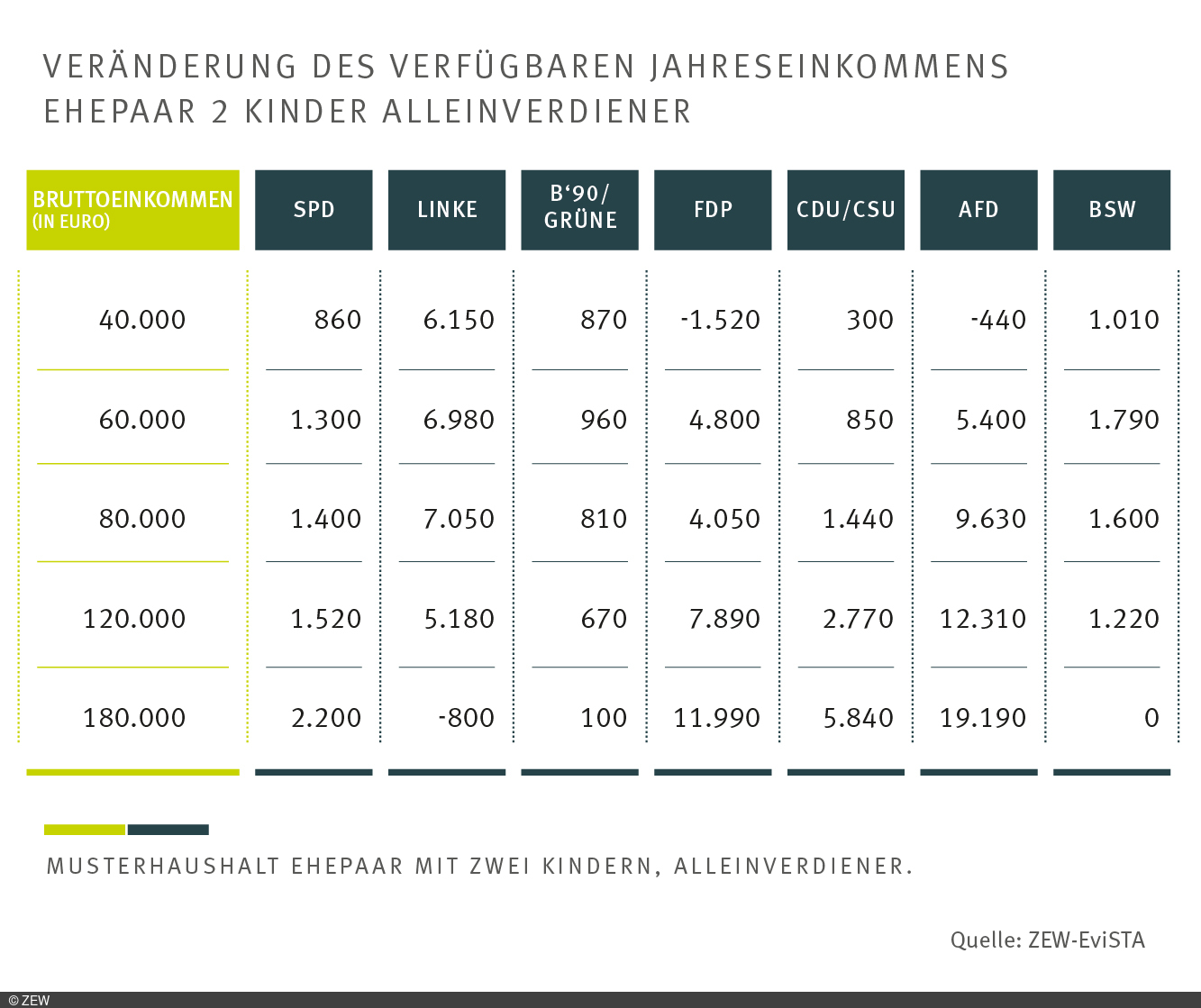
A team from the “Inequality and Distribution Policy” Research Group has analysed the financial impacts that the parties’ programmes for the 2025 federal election would have on household finance and public finances. The researchers examined key reform proposals for taxation, the minimum wage and social benefits and calculated their effects on both the disposable income of different household types as well as on the public budget from social insurance and federal and state budgets
.
The simulations reveal significant differences between the party programmes. The programmes of the SPD, the Green Party, the Left Party and the Sahra Wagenknecht Alliance (BSW) would primarily provide relief for low- and middle-income households. This relief would generally be financed through higher taxes on higher-income groups or through additional public revenues. In contrast, in the programmes of CDU/CSU, FDP and AfD, the level of relief increases more strongly with income, meaning that higher-income households would benefit disproportionately.
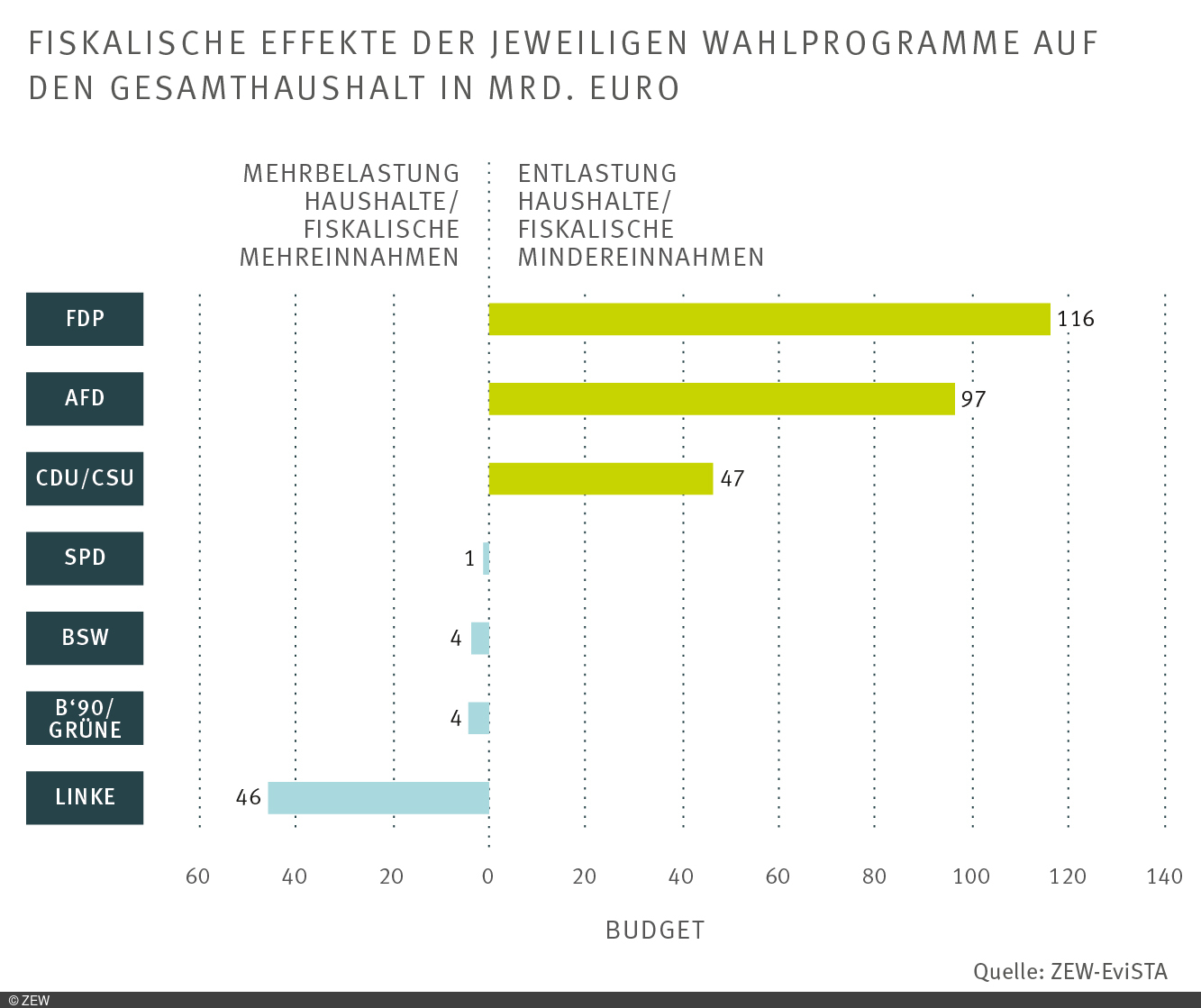
There are also significant differences in the effects on the public budget. According to the proposals of the SPD, the Green Party, the Left Party and BSW, total public expenditure would increase, whereas the programmes of CDU/CSU, FDP and AfD would lead to lower public revenues. Conversely, this means that more funds remain with the state or are returned to private households to a greater extent.
Which calculations were made?
The ZEW researchers examined the financial effects of reform proposals put forward by different parties. The calculations are based on data from the Socio-Economic Panel (SOEP).
They take into account the programmes of the parties currently represented in the Bundestag and of the Sahra Wagenknecht Alliance. If a proposal in a manifesto was worded too vaguely, the researchers made plausible assumptions based on political decisions and statements made by the respective party.
The calculations were made in cooperation with the daily newspaper “Süddeutsche Zeitung” (SZ). The SZ assisted with researching the election programmes, while ZEW conducted the calculations.
ZEW-Podcast (in German)
Click the button below to reload the content. (I agree to external content being displayed to me. Read more in our privacy policy).
What financial consequences would the parties’ programmes for the 2025 federal election have for private households and the state? In the podcast, ZEW economist Holger Stichnoth explains how the research team analysed the election programmes, what differences emerge between the parties and how the study’s findings should be interpreted.
ZEW Sponsors' Association Prize 2025

The “Prize for the best economic policy advising project” went to Professor Holger Stichnoth and Michael Hebsacker from the ZEW Research Unit “Inequality and Public Policy”. They were honoured for their simulation of the financial effects of the political parties’ election manifestos for the 2025 federal election.
More Information

Inequality and Public Policy
The Research Group “Inequality and Public Policy” analyses the distributional effects of social policies.
More about the Research Unit
Contact

Michael Hebsaker
Technical employee Email michael.hebsaker@zew.de Phone +49 (0)621 1235-382